

Best default: oil that meets your vehicle manufacturer’s requirements. Best conditional option: a qualifying high-mileage formulation. Best conventional option: conventional oil only where your manufacturer permits it. For an oil change for high mileage vehicles in Lubbock, Bolton Oil is best for drivers who want drive-up oil and filter service without an appointment—not mechanical repair.
- For an oil change for high mileage vehicles in Lubbock, manufacturer requirements come before mileage-based marketing.
- Bolton Oil offers drive-up conventional and synthetic oil changes appropriate for the vehicle.
- A high-mileage formulation is an option, not an automatic requirement or a repair for engine problems.
- Choose the required viscosity and performance specification before comparing oil labels.
Why the mileage label matters less
An older vehicle does not automatically need a different oil viscosity or a shorter maintenance interval. The useful question is whether the oil meets the requirements for your particular engine and operating conditions. The odometer adds context; it does not replace those requirements.
For your 2026 oil change decision, start with the owner’s manual, your maintenance records, and any change in oil consumption. A vehicle that runs normally needs a different conversation from one showing a warning light, leaving fresh oil spots, or needing repeated additions between services.
The American Petroleum Institute’s Motor Oil Guide explains oil performance categories and viscosity markings. Your vehicle manufacturer’s instructions determine which requirements apply to your engine. Together, those are a sounder basis for choosing oil than a mileage claim on the front of a container.
What makes the best choice
Use these criteria before choosing an oil change option:
- Manufacturer requirements: Match the required viscosity and performance specifications. A high-mileage label does not override either.
- Engine condition: Separate routine maintenance from new leaks, abnormal noises, warning lights, or changing oil consumption.
- Driving conditions: Follow the manufacturer’s maintenance instructions for the conditions your vehicle actually experiences.
- Service scope: Choose an oil change business for routine oil service and a qualified repair provider for mechanical evaluation.
- Clear recommendations: Ask what oil is proposed, why it fits your engine, and what maintenance is actually due.
The best oil for an older engine is an approved oil for that engine—not simply the bottle with the strongest mileage message.
Oil change options at a glance
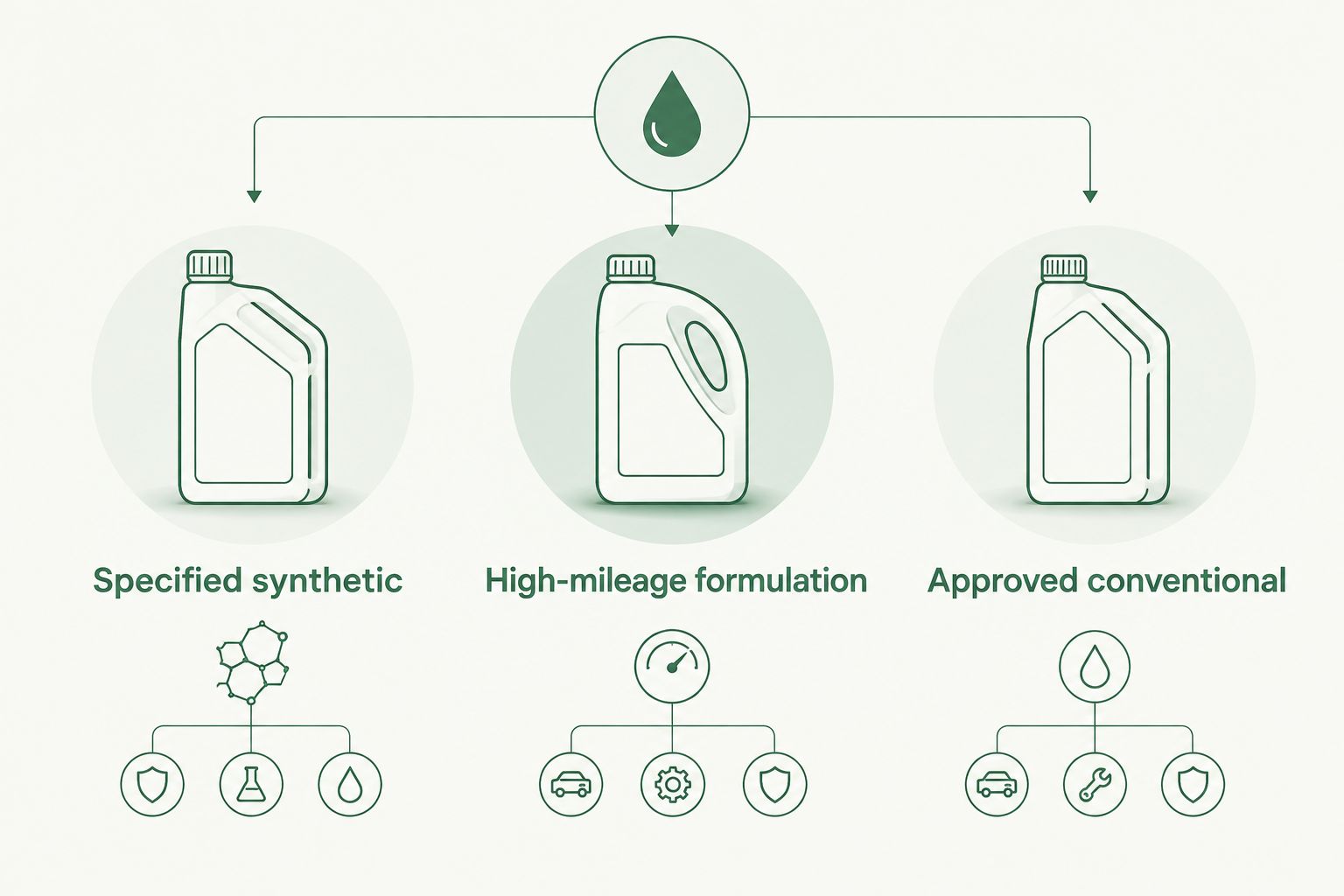
These options describe oil-selection decisions, not a ranking of Lubbock businesses. A high-mileage formulation can also be synthetic, so the categories overlap; the table separates the reasons you would choose each option.
| Option | Best for | Main advantage | Key limitation |
|---|---|---|---|
| Specified synthetic | Engines requiring synthetic oil | Meets the required oil type when viscosity and specifications also match | Synthetic wording alone does not establish compatibility |
| High-mileage formulation | Owners considering a mileage-focused formulation that meets all requirements | Offers an additional formulation choice for an older engine | Does not repair worn parts or establish a longer service interval |
| Approved conventional | Engines whose manufacturer permits conventional oil | Provides an appropriate option where the requirements allow it | Is not a substitute where synthetic oil is required |
The order puts compatibility first. It does not mean every older vehicle should switch to synthetic, or that every vehicle with substantial mileage needs a high-mileage product.
1. Specified synthetic: best when required
If your manufacturer requires synthetic oil, choose synthetic oil that also meets the specified viscosity and performance requirements. High mileage does not remove that requirement. Nor does the word synthetic make every formulation suitable for your engine.
For example, SAE 0W-20 and SAE 5W-30 are different viscosity grades, not interchangeable recommendations. These examples illustrate how oil is identified; neither is a recommendation for your vehicle without checking its requirements.
Specified synthetic pros:
- Follows the required oil type when the manufacturer specifies synthetic.
- Keeps the decision tied to documented engine requirements.
- Avoids treating a vehicle’s age as permission to substitute a different oil.
Specified synthetic cons:
- Requires checking the full specification, not just the synthetic label.
- Does not correct an existing leak or mechanical fault.
Best for: An older vehicle whose manufacturer requires synthetic oil, or permits a suitable synthetic option.
Bolton Oil offers synthetic oil options appropriate for the vehicle. Explain any oil consumption or recent maintenance concerns before service; those details are more useful than asking for the oil generally considered “best for older cars.”
Verdict: Buy a qualifying synthetic oil when your manufacturer requires it.
2. High-mileage formulation: best for consideration
A high-mileage formulation is an option to evaluate, not a requirement triggered by the odometer. These products commonly emphasize additives intended for older engines, including seal-conditioning ingredients. The specific product still has to meet your engine’s viscosity and performance requirements.
Do not treat the label as evidence that an oil will stop a leak, restore worn components, or solve abnormal oil consumption. Those are different claims, and an oil change is not a substitute for identifying a mechanical problem.
High-mileage formulation pros:
- Provides another formulation to consider when it meets all required specifications.
- Keeps attention on the needs of an older engine rather than mileage alone.
- Can be assessed alongside maintenance history and documented oil consumption.
High-mileage formulation cons:
- The mileage label alone does not establish suitability.
- Does not replace mechanical evaluation for a new or worsening problem.
- Does not automatically change the manufacturer’s service interval.
Best for: An owner considering a specific, qualifying high-mileage oil after confirming the vehicle’s requirements.
Ask about the exact formulation rather than requesting a mileage label alone. This recommendation is about how to evaluate the oil category; it is not a claim that a particular high-mileage product is offered at Bolton Oil.
Verdict: Hold until the specific oil’s suitability is confirmed.
3. Approved conventional: best where permitted
Conventional oil remains an option where the vehicle manufacturer permits it and the selected oil meets the applicable requirements. An older vehicle does not automatically require a switch simply because another oil carries a mileage-focused label.
The same reasoning works in the other direction: an older engine that requires synthetic oil should not receive conventional oil merely because it has accumulated more miles. Requirements come first in both cases.
Approved conventional pros:
- Provides a suitable option for engines whose requirements permit it.
- Keeps the selection grounded in the vehicle’s documented needs.
- Avoids an automatic switch based solely on odometer mileage.
Approved conventional cons:
- Is not appropriate where the manufacturer requires synthetic oil.
- Still requires the correct viscosity and performance specifications.
Best for: A vehicle whose manufacturer allows conventional oil and whose maintenance needs do not call for a different approved choice.
Bolton Oil offers conventional oil options appropriate for the vehicle. Bring your maintenance information if you have it, especially when you are unsure what oil was used previously.
Verdict: Buy only when conventional oil meets your vehicle’s requirements.
Separate maintenance from repair
A routine oil change and a repair visit solve different problems. If your vehicle is running normally and service is due, an oil and filter change fits the task. If oil consumption has increased or a fresh leak has appeared, replacing the oil alone does not explain the cause.
An oil-pressure warning deserves immediate attention. Follow the vehicle’s warning instructions rather than continuing to drive to a routine oil change visit. Do not assume a warning means only that the next service is overdue.
Useful information to bring includes:
- Maintenance history: The last oil change date, mileage, and oil specification, if recorded.
- Oil additions: Whether you have needed to add oil between changes and whether that pattern has changed.
- New symptoms: Fresh spots beneath the vehicle, smoke, warning messages, or unusual noises.
Bolton Oil specializes in oil changes and closely related maintenance, not general mechanical diagnosis or engine repair. That distinction helps you choose the right next stop instead of expecting an oil change to solve a repair problem.
What West Texas changes
Dust matters when it matches the conditions described in your manufacturer’s maintenance schedule. Do not assume every vehicle in Lubbock needs the same shortened interval, and do not create a new interval simply because the engine has high mileage.
Check the manual’s instructions for dusty conditions and other applicable operating conditions. Follow the requirements for your actual use, not just your ZIP code. A vehicle regularly traveling dusty roads has a different usage history from one driven mainly on paved streets.
An engine air filter check is also relevant to that conversation. Oil service and air filtration are separate maintenance items; changing the oil does not establish that the air filter needs replacement. Ask for the condition and recommendation to be explained before authorizing additional work.
What to expect during service
You can visit any of the three Lubbock locations during business hours without an appointment and stay in your vehicle during service. Oil and filter service is the central task. Engine air filter checks, fluid checks and applicable top-offs, and tire pressure checks are among the advertised related offerings.
Before work begins, make the decision clear: which oil meets the vehicle’s requirements, what service is proposed, and whether any concern belongs with a repair provider instead. Bolton Oil uses everyday low prices with no coupon needed; there is no need to organize your maintenance around a promotional code.
Drive-up service does not mean a guaranteed wait or completion time. Leave room in your plans rather than treating “quick” as a promise of a fixed number of minutes.
How these options are ranked
The ranking follows manufacturer compatibility, engine condition, and service fit. Required synthetic comes first when it applies; a high-mileage formulation remains conditional; conventional oil belongs only where permitted. No local competitor ranking or claimed product test is needed to make that decision.
Which option should you choose?
Choose the manufacturer-specified oil and an appropriate filter as your default. Consider a high-mileage formulation only after confirming that the specific product meets those same requirements. If your vehicle has a new symptom, address the symptom instead of trying to select an oil around it.
For routine service, bring the vehicle information and any useful maintenance records. That gives the conversation a practical starting point and keeps the recommendation focused on your engine.
FAQ
Does an older car need thicker oil?
An older car does not automatically need thicker oil. Use the viscosity specified by the manufacturer unless the manufacturer provides an applicable alternative; vehicle age alone is not a reason to change grades.
Can I switch back from synthetic to conventional oil?
Use conventional oil only if it meets your vehicle manufacturer’s requirements. Having used synthetic previously does not replace the need to check the required oil type, viscosity, and performance specifications.
Should I change oil before a long trip if the service is not due?
Check the manufacturer’s schedule and your current maintenance status before deciding. Confirm the oil level according to the owner’s manual and address leaks or warning messages before traveling.
Does a high-mileage oil change include an engine flush?
A high-mileage oil label does not establish that an engine flush is needed or included. Bolton Oil’s approved service information does not advertise engine flushes.
Can an oil change diagnose why my car burns oil?
An oil change does not diagnose the cause of oil consumption. A new or worsening consumption pattern needs evaluation by a qualified repair provider, particularly when accompanied by smoke or other symptoms.
Can I get tire rotation with my oil change?
Bolton Oil does not offer tire rotation. Tire pressure checks and inflation are advertised offerings, but they are different from rotating, repairing, or replacing tires.
One last thing
At your next visit, keep the service record showing the oil used and the vehicle’s mileage. A clear record gives you something concrete to compare when the next oil change comes around—more useful than remembering only that you chose “high-mileage oil.” Stop by during business hours when routine oil service is due.
Related guides
- Engine air filter replacement options for West Texas
- Oil change specials and coupons in Lubbock
- Quick oil change service options in Lubbock