

Best overall: full synthetic that matches your engine’s viscosity and required specifications. Best for approval-specific engines: the exact manufacturer-approved formula. Best for older engines: a compatible high-mileage synthetic—not automatically a thicker oil. The best synthetic oil for summer heat is the right oil for your engine, not whichever bottle makes the strongest heat claim.
- The best synthetic oil for summer heat matches your vehicle’s required viscosity and performance specifications.
- West Texas heat alone is not a reason to switch to thicker engine oil.
- High-mileage and diesel synthetics serve different needs; neither is a universal upgrade.
- Bolton Oil Change offers synthetic oil change options appropriate for your vehicle, without an appointment.
For a local service option, Bolton Oil provides conventional and synthetic oil changes at three Lubbock locations. This guide ranks oil categories by vehicle fit rather than naming a winning bottle without knowing your engine or its requirements.
Why summer oil choice matters
West Texas summer driving raises a useful question: does your current oil still meet what your engine needs? Start with the owner’s manual, not the outdoor temperature. Engine oil selection depends on viscosity, performance specifications, and any required manufacturer approval.
Full synthetic oils generally offer better resistance to oxidation and stronger low-temperature performance than conventional formulations. That does not make every synthetic interchangeable. A bottle can say full synthetic and still be wrong for your vehicle.
For summer 2026, the practical goal is straightforward: use an approved oil, maintain the correct level, and follow the maintenance schedule that applies to your driving.
What makes a good synthetic
These criteria matter more than a brand ranking:
- Correct viscosity: Use the SAE grade specified for your engine, such as 0W-20 or 5W-30. Follow any temperature-based alternatives in the manual.
- Required performance specification: Match the oil standard your manufacturer calls for, not just the word synthetic.
- Manufacturer approval: If your engine requires a particular approval, confirm that the exact oil carries it.
- Correct engine application: Gasoline and diesel requirements differ. A familiar brand name does not establish compatibility.
- Appropriate maintenance schedule: An oil’s marketing language does not replace your vehicle’s oil-life monitor or maintenance instructions.
The strongest summer oil choice is the one you can verify against your vehicle’s requirements. Specialty labels come after that check, not before it.
Summer oil picks at a glance
These are buying categories, not a claim that one formula outperformed another in testing. Start with the category that describes your engine, then verify the individual oil.
| Oil category | Best for | Standout consideration | Key limitation |
|---|---|---|---|
| Specification-matched full synthetic | Gasoline engines without a separate approval requirement | Matches the required viscosity and performance standard | Full synthetic alone does not prove suitability |
| Manufacturer-approved full synthetic | Engines requiring a named manufacturer approval | Meets the engine’s specific approval requirement | The exact formulation matters, not just the brand |
| Compatible high-mileage full synthetic | Older gasoline engines whose requirements allow it | Adds a high-mileage formulation option without abandoning required specifications | Does not repair leaks or mechanical wear |
| Engine-approved diesel synthetic | Diesel vehicles requiring diesel-specific oil | Matches the diesel engine and emissions-system requirements | A gasoline-engine recommendation is not enough |
1. Specification-matched full synthetic: everyday gasoline use
Best for: gasoline engines whose manuals specify a viscosity and performance standard without an additional manufacturer approval.
This is the default starting point for choosing the best synthetic oil for summer heat. Find a full synthetic that satisfies every requirement in your manual, then compare suitable options rather than comparing unrelated formulas.
For example, a 0W-20 recommendation and a 5W-30 recommendation describe different viscosity grades. Neither is universally better for Lubbock summer driving; the engine’s instructions decide which belongs in the crankcase.
Specification-matched full synthetic pros:
- Keeps the choice tied to documented vehicle requirements.
- Provides the oxidation-resistance benefits associated with synthetic formulations.
- Avoids adding a specialty category your engine does not require.
Specification-matched full synthetic cons:
- Requires more label checking than simply choosing synthetic.
- Does not justify extending the vehicle’s service interval on its own.
Verdict: Buy a specification-matched full synthetic when it meets your engine’s complete requirements.
2. Manufacturer-approved full synthetic: approval-specific engines
Best for: vehicles whose manuals require a named manufacturer oil approval.
Some engines require more than a viscosity grade and a general industry standard. Their manufacturers specify an approval addressing additional performance requirements. In that situation, choose the exact approved formulation rather than assuming a whole brand’s synthetic range qualifies.
Check the label and the oil manufacturer’s technical information. A product description that mentions a vehicle brand is not a substitute for confirming the approval your manual requires.
Manufacturer-approved full synthetic pros:
- Addresses the engine’s stated approval requirement.
- Makes the comparison more precise than brand-versus-brand shopping.
- Helps distinguish similar-looking oils with different applications.
Manufacturer-approved full synthetic cons:
- Requires checking the particular formulation and viscosity.
- Approval language needs closer attention than a general synthetic label.
Verdict: Buy the required manufacturer-approved synthetic; skip substitutes that do not establish compliance.
3. Compatible high-mileage synthetic: older gasoline engines
Best for: older gasoline vehicles when a high-mileage formulation also meets the engine’s requirements.
High-mileage oils commonly include additive packages intended for aging engines, including seal-conditioning components. That makes this category worth considering, but mileage alone does not establish that your vehicle needs it.
Keep the specified viscosity and performance requirements at the center of the decision. A high-mileage label is not permission to use thicker oil or an explanation for a new leak.
Compatible high-mileage synthetic pros:
- Offers a formulation intended for aging-engine needs.
- Can preserve the required viscosity when a suitable product is selected.
- Gives owners an additional option without automatically changing oil grade.
Compatible high-mileage synthetic cons:
- Does not fix damaged seals, worn parts, or other mechanical problems.
- Is unsuitable if the particular oil fails to meet required specifications.
For related service considerations, see the guide to oil change options for high-mileage vehicles.
Verdict: Buy only when compatible and appropriate; skip it as a substitute for investigating oil loss.
4. Engine-approved diesel synthetic: diesel applications
Best for: diesel vehicles whose manuals specify diesel oil standards and related approvals.
Diesel engines need oil selected for their own requirements, including compatibility with their emissions equipment. Do not choose a diesel oil simply because the vehicle is a truck, or a gasoline oil simply because it is synthetic.
The exact engine matters. Some oils carry more than one application rating, but the label must establish that the product meets the requirement for your vehicle.
Engine-approved diesel synthetic pros:
- Keeps selection tied to diesel-specific performance needs.
- Accounts for manufacturer requirements affecting emissions-system compatibility.
- Avoids treating all pickup engines as the same application.
Engine-approved diesel synthetic cons:
- Requires checking engine-specific requirements carefully.
- Is not a universal upgrade for gasoline vehicles.
This is an oil-selection category, not a claim about a particular diesel vehicle’s service eligibility at Bolton Oil Change. Confirm that your vehicle’s oil and filter requirements can be met before service.
Verdict: Buy the diesel synthetic your engine requires; skip cross-application guesses.
Read viscosity without guessing
The SAE viscosity grade describes oil behavior, not overall quality. In a multigrade oil, the number before W relates to low-temperature performance; the second number identifies the high-temperature viscosity grade.
SAE J300 uses viscosity measurements at 100°C, equivalent to 212°F, as part of its high-temperature classification. Those are test conditions—not outdoor temperature ratings, oil-change intervals, or maximum safe operating temperatures.
That distinction matters when comparing 0W-20 and 5W-30. A higher second number is not automatically better protection for an engine designed around a different grade.
Do not switch to thicker oil solely because summer has arrived. If your manual lists temperature-dependent alternatives, follow those instructions. Otherwise, keep the specified grade.
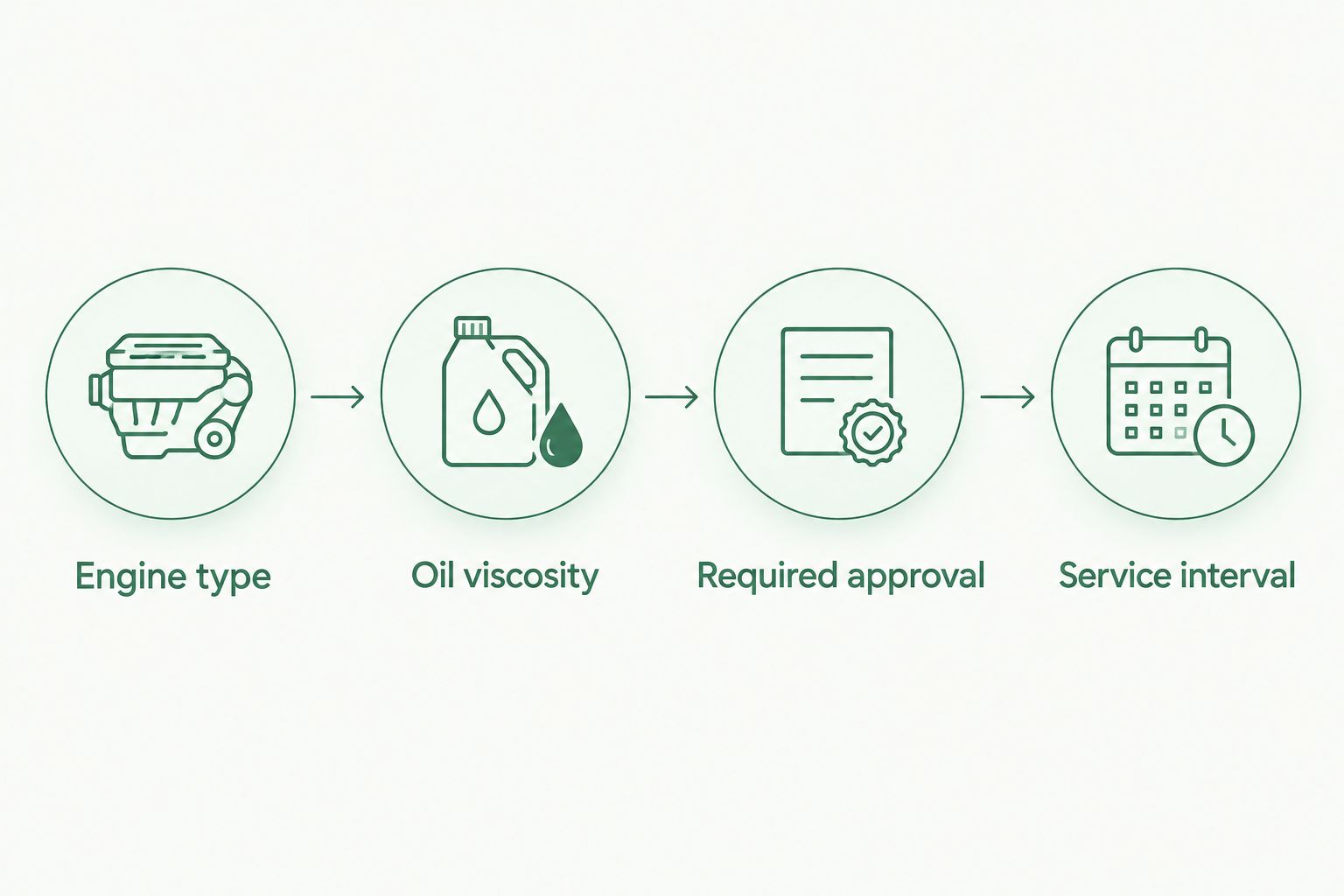
Choose oil in four steps
Use this sequence before your next summer oil change:
- Engine type: Identify the exact engine, including gasoline or diesel. A model name alone does not always settle the oil requirement.
- Oil viscosity: Find the recommended SAE grade in the manual. Check any listed temperature-related alternatives rather than assuming one exists.
- Required approval: Record the performance standard and any manufacturer approval, then match the exact oil.
- Service interval: Follow the applicable maintenance schedule or oil-life monitor instructions, including any relevant severe-service provisions.
Bring that information with you if you have questions. It gives the conversation a useful starting point and avoids choosing oil from a bottle’s front label alone.
Dust and towing need context
Summer heat is only part of the West Texas maintenance picture. Dusty-road use, towing, extended idling, and repeated short trips are conditions that vehicle manufacturers address in their maintenance guidance, though definitions and schedules vary.
Check whether your actual driving meets your manual’s severe-service conditions. Do not invent a shorter interval because it feels prudent, and do not stretch an interval because the bottle promises extended performance.
Dust also makes engine air filter maintenance relevant. Follow the manufacturer’s inspection and replacement guidance; the guide to engine air filter replacement for West Texas driving covers that separate maintenance decision.
An oil change does not replace cooling-system repair or mechanical diagnosis. If your vehicle overheats, loses oil unexpectedly, or displays an oil-pressure warning, address the warning rather than treating a different synthetic as the fix.
How these picks are ranked
The order reflects decision priority: complete vehicle compatibility first, then approval-specific needs, aging-engine considerations, and diesel applications. It is not a laboratory ranking or a claim that one manufacturer’s oil lasts longer than another.
Technical references for this 2026 guide are SAE International’s J300 viscosity classification, the American Petroleum Institute’s Motor Oil Guide, and your vehicle manufacturer’s owner’s manual. The vehicle-specific manual controls the final recommendation.
Which synthetic should you choose?
Choose a full synthetic that matches the required viscosity, performance standard, and manufacturer approval. Add a high-mileage designation only when it remains compatible and serves a relevant need. Choose diesel oil by diesel-engine requirements, not by truck size or summer temperature.
Bolton Oil Change is best for drivers who want a drive-up synthetic oil change without an appointment. We provide oil changes and closely related maintenance, not engine repair or general mechanical diagnostics. Stop by during business hours with your vehicle information and any questions about the required oil.
FAQ
Can I mix different synthetic oil brands when topping off?
The required viscosity and specifications matter more than matching brand names. Check your owner’s manual for topping-off instructions, and do not assume two synthetic oils meet the same requirements.
Does synthetic oil mean I can ignore the oil-life monitor?
No. Follow your vehicle manufacturer’s oil-life monitor and maintenance instructions; choosing synthetic does not independently authorize a longer interval.
Should I change my oil before a summer road trip?
Change it if it is due under your vehicle’s maintenance guidance, not simply because a trip is coming. Check the oil level and review the expected driving conditions before leaving.
Is darker engine oil proof that it needs changing?
No. Color alone does not establish whether engine oil needs replacement. Use the maintenance schedule, oil-life monitor, and any relevant professional assessment rather than appearance alone.
Does premium gasoline replace the need for better engine oil?
No. Fuel octane and engine oil specifications address different requirements. Follow your manufacturer’s instructions for each rather than treating one as a substitute for the other.
What if I cannot find my owner’s manual?
Look for the manufacturer’s official manual for your exact model year and engine. Confirm that it matches your vehicle before using its oil specifications or maintenance schedule.
One last thing
Before your next visit, save a photo of the manual’s oil-requirements page. Include the viscosity, performance specification, and any approval language—not just the oil filler cap. That small reference makes a summer oil decision much clearer.
Related guides