

Home healthcare workers’ oil change planning is vehicle maintenance organized around home visits, with the aim of keeping required service from becoming a last-minute scheduling problem. This 2026 guide explains how to use your vehicle’s maintenance instructions, recognize relevant route conditions, and choose a service window without treating the gap between patients as a guaranteed opening.
- An oil change for home healthcare workers should follow vehicle requirements, not a universal mileage rule.
- Bolton Oil Change suits workers seeking drive-up oil changes without an appointment in Lubbock.
- Describe short trips, idling, and dusty roads when discussing the manufacturer’s maintenance schedule.
- Keep vehicle service records separate from patient information and employer mileage records.
Why route-based maintenance matters
A home-visit schedule creates a practical maintenance question: where does vehicle service fit without interfering with patient appointments? Your work calendar tells you when you need the car. Your owner’s manual tells you what maintenance the car needs. Neither replaces the other.
Bolton Oil Change is best for home healthcare workers seeking drive-up oil changes without an appointment. You can visit any of our three Lubbock locations during business hours and stay in your vehicle during service. The Bolton Oil Change website is the starting point for planning a visit.
That convenience has a boundary: no appointment does not mean no wait. Choose a window with room for service rather than assuming an oil change will fit between closely scheduled home visits.
Build a workable service routine
Start with your vehicle’s instructions
Find the maintenance schedule for your exact vehicle before choosing an interval. Use the owner’s manual, the manufacturer’s owner resources, and any applicable oil-life instructions. A coworker’s schedule is not a substitute, even when both of you cover similar routes.
Look for both mileage and elapsed-time requirements. If your vehicle has an oil-life monitor, follow the manufacturer’s explanation of how to use it, including any maximum interval or other conditions. Do not replace those instructions with a universal mileage number from an advertisement.
Save the relevant pages on your phone so you can check them without searching during a workday. A photograph of the oil requirements and maintenance schedule is often enough to make the next conversation more useful.
- Record the vehicle’s model year, engine, and current odometer reading.
- Find the specified oil viscosity and required performance standard.
- Check the manufacturer’s mileage and time instructions.
- Read the oil-life monitor instructions, if equipped.
- Note any maintenance schedule for special operating conditions.
Match the schedule to your routes
Describe how you actually use the vehicle, not just how far you drive. Repeated short trips, extended idling, and dusty-road use appear in some manufacturers’ special-operating-condition guidance. The definitions and maintenance requirements depend on the vehicle.
Your occupation alone does not establish a severe-service schedule. A route with longer drives between homes differs from one with frequent stops close together. Compare your actual use with the conditions listed in your manual rather than deciding that every healthcare work vehicle needs the same interval.
West Texas dust is relevant when your route includes dusty roads, not simply because your address is in Lubbock. Describe those roads accurately and ask which manufacturer instructions apply.
- Note whether your visits involve short drives or longer trips.
- Identify any regular periods of extended idling.
- Mention unpaved or visibly dusty roads on your route.
- Compare those conditions with the manual’s exact wording.
- Ask for an explanation before changing your maintenance interval.
Choose a realistic service window
Start with your calendar. Look for a period when a delay will not put a patient visit, school pickup, or another fixed commitment at risk. A day with fewer scheduled visits is a better planning opportunity than a narrow gap that only works if everything runs perfectly.
For routine oil service, Bolton Oil Change offers a drive-up option without appointments. That removes the need to reserve a service slot, but it does not establish a completion time. Check business hours and leave flexibility in your schedule.
If your employer controls vehicle maintenance or uses a company-owned car, confirm the approval process first. Do not assume a convenient provider is an authorized provider under your employer’s policy.
- Pick a window without an immediately following patient appointment.
- Confirm business hours before leaving your route.
- Check employer authorization rules for work vehicles.
- Bring the vehicle information and maintenance instructions you saved.
- Allow for a wait rather than building your plan around no-wait service.
Confirm the oil and service scope
Ask which oil meets your vehicle’s requirements and what the oil change includes. Conventional versus synthetic is not simply a preference question: the oil must meet the specifications for the engine. If you are comparing options, make the vehicle requirement the first filter.
Bolton Oil Change provides conventional and synthetic options appropriate for the vehicle, along with oil filter replacement. Related offerings include engine air filter checks and replacement, applicable fluid checks and top-offs, and tire pressure checks and inflation.
Keep additional recommendations specific. An oil change, an engine air filter replacement, and a fuel system service are separate maintenance decisions. Ask what prompted each recommendation rather than treating them as an automatic package. For dusty routes, the guide to engine air filter replacement provides a relevant next topic.
- Confirm the required oil specification before approving service.
- Ask what is included and what is separate.
- Request an explanation for any additional maintenance recommendation.
- Keep routine maintenance separate from diagnosis of a vehicle problem.
- Review the service details before leaving.
Keep a useful service record
A receipt is more useful when you can find it at the next visit. Keep a vehicle-only folder on your phone or in your records, and save the service date, odometer reading, oil information, and work performed.
Do not mix patient names, addresses, care notes, or route details into that folder. Vehicle maintenance records and clinical information serve different purposes. Keeping them separate also makes it easier to share a service receipt without sharing unrelated information.
Employer reimbursement is a separate question. A service receipt documents the work performed; it does not establish that your employer will reimburse the expense. Follow the policy that applies to your role and vehicle ownership.
- Save the itemized receipt in a vehicle-only folder.
- Record the service date and odometer reading.
- Retain the oil specification and filter details shown on the receipt.
- Keep patient information out of maintenance notes.
- Follow employer rules for expense submission separately.
Set reminders you can use
Set your next reminder using the manufacturer’s instructions and your current service record. A reminder should give you time to plan, not first appear when you have already reached the service deadline.
For a changing route, a calendar alert and an odometer check serve different purposes. The calendar tracks elapsed time; the odometer tracks distance. Use both when the manufacturer’s schedule requires both, and follow any applicable oil-life monitor instructions.
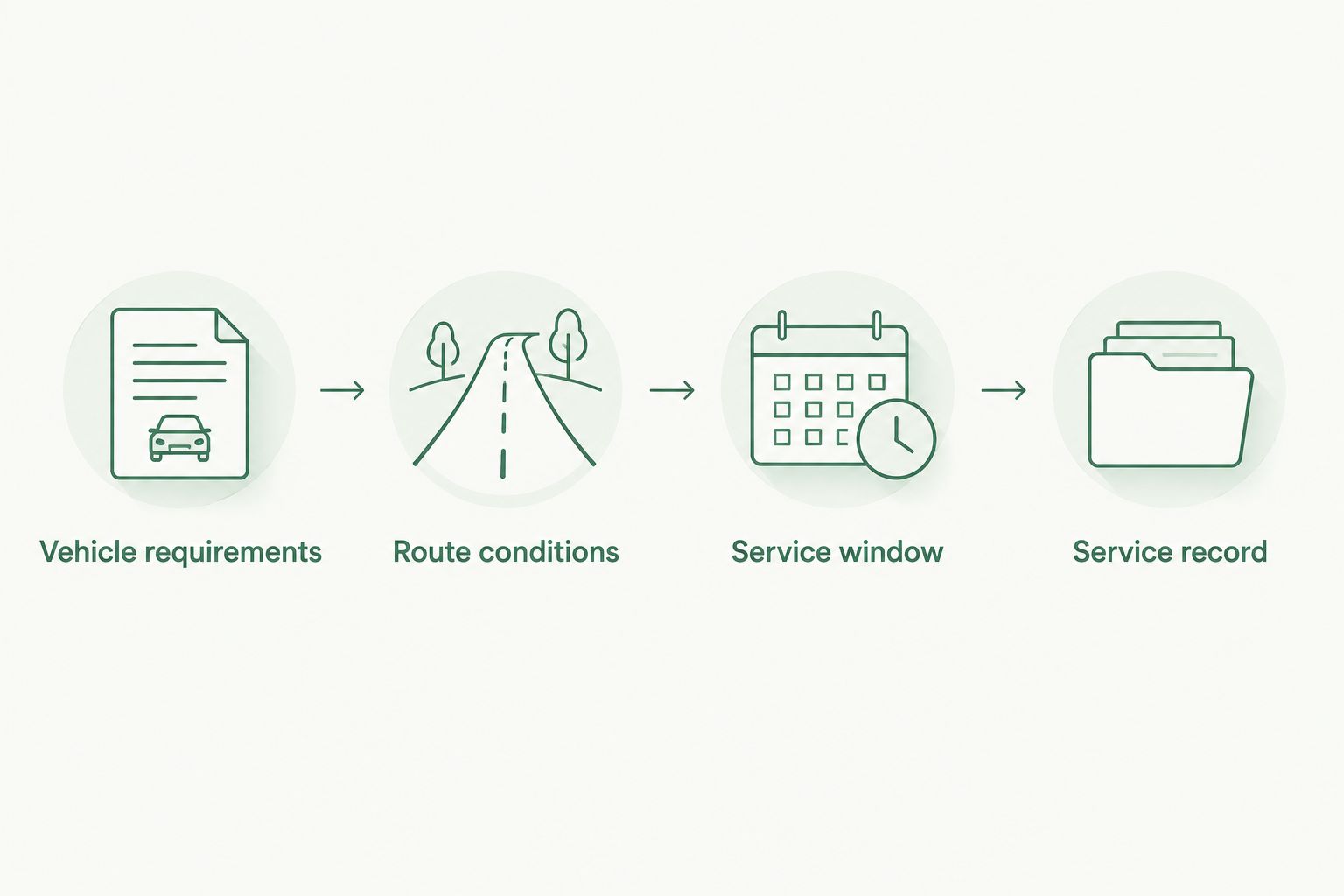
Keep the routine simple enough to maintain during a busy week. The useful sequence is Vehicle requirements, Route conditions, Service window, Service record: know what is required, describe your use, plan the visit, and document the result.
A reminder is an organizational tool, not a diagnosis. If a warning or unusual symptom appears before scheduled maintenance, follow the vehicle’s instructions rather than waiting for the next calendar alert.
- Enter the next service reminder after each oil change.
- Track elapsed time and mileage as the manufacturer directs.
- Revisit your plan when your work route changes substantially.
- Keep the latest service record easy to retrieve.
- Treat warning indicators separately from routine scheduling.
Compare your service options
Choose the service format around the work needed, not simply the nearest opening in your day. Routine oil maintenance and mechanical diagnosis require different capabilities.
| Option | Best for | Practical advantage | Key limitation |
|---|---|---|---|
| Bolton Oil Change | Routine drive-up oil changes in Lubbock | No appointment needed; stay-in-your-vehicle service | Not a full-service repair provider; no guaranteed wait or completion time |
| Manufacturer dealership service department | Vehicle-specific maintenance or questions about manufacturer procedures | A place to discuss manufacturer-directed service and applicable vehicle concerns | Confirm scheduling, scope, and expected vehicle downtime directly |
| Independent repair shop | Mechanical concerns beyond routine oil service | An option when the vehicle needs diagnosis or repair | Capabilities and scheduling differ; confirm the specific work offered |
| Do-it-yourself oil change | Owners with the knowledge, equipment, and safe workspace | Direct control over the task and service record | Requires correct materials, safe working practices, and proper used-oil disposal |
Choose the provider for the job you need. Bolton specializes in oil changes and closely related maintenance, not brake repair, tire repair or rotation, engine repair, transmission repair, or general mechanical diagnosis. If your concern falls outside that scope, arrange appropriate repair service instead of expecting an oil change to address it.
Mistakes that disrupt a workday
Treating a visit gap as guaranteed
A gap in your patient schedule is not a reserved service bay. Avoid planning a maintenance stop that leaves no room for a wait or a change in your work route.
Copying another worker’s interval
Two home healthcare workers can drive different engines under different conditions. Use your own vehicle’s instructions, even if a coworker’s mileage or oil choice sounds convenient.
Approving an unclear maintenance package
Ask what each item does and why it is being recommended. Your job title does not make every additional service necessary, and routine oil maintenance is not a substitute for investigating a specific problem.
Combining clinical and vehicle records
Do not attach patient schedules or visit notes to an oil-change receipt. Keep only the vehicle information needed for maintenance and handle work-related expense documentation through the appropriate employer process.
FAQ
Can I get an oil change while I stay in my vehicle?
Bolton Oil Change offers stay-in-your-vehicle convenience during oil change service. Follow the crew’s directions while your vehicle is being serviced.
Does driving for work automatically qualify my car for severe service?
No, driving for work does not automatically establish a severe-service interval. Compare your actual operating conditions with the definitions and maintenance instructions for your vehicle.
Can an oil change fix an oil-pressure warning?
Do not assume an oil change will fix an oil-pressure warning. Follow the warning instructions in your owner’s manual promptly and arrange appropriate professional assistance; Bolton does not provide general mechanical diagnosis or engine repair.
Should I change oil before a temporary rural assignment?
Base that decision on your current maintenance status and the vehicle manufacturer’s instructions, not the assignment alone. Check whether the expected mileage or operating conditions will bring required service due during the assignment.
Can I bring an employer-owned vehicle for service?
Confirm your employer’s authorization and payment procedures before bringing an employer-owned vehicle for service. Do not assume that a provider accepts a particular fleet arrangement or employer billing method.
Should I check the oil level between oil changes?
Follow your owner’s manual for oil-level checks between services. Use its checking procedure and required oil specification rather than treating the next scheduled oil change as the only time oil needs attention.
Make the next visit easier
Before your next service, save the maintenance-schedule page alongside the latest receipt. That small step gives you something more useful than a remembered mileage number: the vehicle’s instructions and a record of what was actually done.
When routine oil service is due, choose a window with breathing room and stop by one of our three Lubbock locations during business hours. Bring your questions, too. A clear explanation belongs in the visit.
Related guides
- Oil change planning for long-distance commuters
- Oil change intervals and West Texas driving conditions
- DIY versus professional oil changes