

The best oil change interval for West Texas driving is the schedule your vehicle manufacturer assigns to your actual use—not a mileage rule based on your ZIP code. Choose the severe-service schedule when your driving meets its conditions, follow an oil-life monitor when the manufacturer directs you to, and use the normal schedule only when your driving qualifies.
- For West Texas driving, the best oil change interval comes from your vehicle’s maintenance schedule and actual operating conditions.
- Dust, towing, idling, and short trips matter when your manufacturer lists them as severe-service conditions.
- Bolton Oil Change suits drivers who want drive-up oil and filter service without an appointment.
- Low annual mileage does not cancel a manufacturer’s time-based oil change requirement.
Why driving conditions matter
A commute on paved roads and regular work on dusty access roads aren't the same maintenance situation. Neither is a lightly loaded car and a truck that regularly tows. The useful question is which conditions your vehicle's maintenance instructions actually address.
Bolton Oil provides oil changes and closely related maintenance, not general mechanical repair. This guide helps you choose the right scheduling method before your next visit, without inventing a universal West Texas mileage interval.
What makes the best interval
Rank oil change schedules by how well they match your vehicle and driving—not by which one promises the longest gap between visits.
- Manufacturer authority: The schedule must apply to your vehicle's model year, engine, and configuration.
- Driving-condition match: Use the manufacturer's definitions of normal and severe operation rather than guessing from the weather.
- Correct oil specification: An interval assumes the oil meets the vehicle's stated requirements.
- Mileage and elapsed time: Follow both limits when the maintenance schedule gives both.
- Clear tracking: Keep enough service information to know when the next change is due.
For your 2026 maintenance plan, start with the owner's manual and any separate maintenance booklet. A generic interval chart cannot replace those instructions.
Oil change schedules at a glance
These options are ranked by the situation they solve. They aren't competing oil products, and the shortest interval isn't automatically the best choice.
| Rank and scheduling method | Best for | Main advantage | Key limitation |
|---|---|---|---|
| 1. Manufacturer severe-service schedule | Driving that meets listed severe conditions | Accounts for qualifying demanding use | Definitions and requirements vary by vehicle |
| 2. Manufacturer-directed oil-life monitor | Vehicles whose instructions direct owners to the monitor | Provides a vehicle-specific service prompt | Requires correct use, reset, and attention to other limits |
| 3. Manufacturer normal-service schedule | Driving that does not meet listed severe conditions | Gives a defined mileage or time framework | Becomes the wrong choice when driving conditions change |
| 4. Manufacturer time-based limit | Vehicles driven infrequently | Prevents mileage alone from controlling the decision | Does not replace earlier mileage or monitor requirements |
Bolton Oil Change is best for drivers who want drive-up oil change service without an appointment. Choosing the interval still starts with the vehicle manufacturer's instructions.
1. Severe service: best for demanding use
The manufacturer severe-service schedule is the first choice when your driving meets the conditions listed for your vehicle. Owner's manuals commonly address conditions such as dusty roads, repeated short trips, extended idling, or towing, but the definitions and required maintenance differ.
A West Texas address alone doesn't establish severe use. Describe the actual driving: road surface, trip pattern, time spent idling, and whether the vehicle carries or tows loads.
Severe-service schedule pros:
- Connects maintenance to conditions the manufacturer identifies.
- Gives a documented basis for changing your routine.
- Helps distinguish demanding operation from ordinary driving.
Severe-service schedule limitations:
- Another vehicle's definition doesn't establish yours.
- Severe-service requirements can differ by maintenance item; don't assume every listed task shares an interval.
Dust deserves particular attention without becoming an excuse for blanket recommendations. Engine air filter maintenance and engine oil maintenance are separate decisions. Our guide to engine air filter replacement for West Texas drivers addresses that related service; an air filter check doesn't establish when your engine oil is due.
Best for: Drivers whose regular use matches their manufacturer's severe-service description.
Verdict: Use the severe-service instructions when your driving qualifies. Don't substitute a shorter interval chosen without reference to the manual.
2. Oil-life monitor: best for directed tracking
A manufacturer-directed oil-life monitor is the right scheduling method when your vehicle's instructions tell you to follow it. Read those instructions alongside the display. Depending on the vehicle, the manual also specifies an elapsed-time limit or other requirements.
An oil-life display and an oil-pressure warning are different things. Treat an oil-pressure warning according to the vehicle's safety instructions; it isn't a routine reminder to arrange an oil change later.
Oil-life monitor pros:
- Gives you a service prompt within the vehicle.
- Supports the manufacturer's intended maintenance method.
- Reduces reliance on remembering mileage alone.
Oil-life monitor limitations:
- A reset doesn't prove that an oil change occurred.
- The display doesn't replace oil-level checks or other instructions in the owner's manual.
After an oil change, confirm that any required monitor reset was completed. If you're unsure whether a previous owner reset the monitor without servicing the vehicle, use maintenance records to establish what actually happened rather than treating the display as proof.
Best for: Owners of vehicles whose manufacturer specifies oil-life monitoring as the scheduling method.
Verdict: Follow the monitor together with every applicable manual requirement. Don't treat the display as permission to ignore elapsed time, oil level, or warning messages.
3. Normal service: best for qualifying routine driving
The manufacturer normal-service schedule fits driving that does not meet the vehicle's listed severe-service conditions. Regular paved-road use can belong here, but “mostly highway” isn't enough information by itself. Towing, idling, and other listed conditions still need consideration.
The normal schedule isn't an inferior choice. It's the appropriate choice when the manufacturer's conditions support it.
Normal-service schedule pros:
- Provides a defined maintenance framework.
- Avoids adopting another driver's interval without a reason.
- Makes planning straightforward when your driving remains consistent.
Normal-service schedule limitations:
- A change in work, route, or vehicle use can change the applicable schedule.
- It doesn't override a manufacturer-directed monitor or a separate requirement for your engine.
Revisit the classification when your routine changes. A vehicle used for an ordinary commute can later spend substantial time on unpaved roads or towing; the old calendar entry doesn't decide whether the old schedule still fits.
Using synthetic oil also doesn't, by itself, authorize a longer interval. Follow the oil specification and scheduling instructions together rather than applying a general claim from an oil label.
Best for: Drivers whose use fits the manufacturer's normal-service conditions.
Verdict: Use the normal schedule when your driving qualifies, and reassess it when your routine changes.
4. Time limit: best for low-mileage vehicles
The manufacturer's time-based limit matters when you drive infrequently. If your maintenance instructions specify both mileage and elapsed time, follow whichever comes first. Low mileage doesn't erase the calendar requirement.
This is usually a limit within the applicable maintenance schedule, not a separate program you choose instead of mileage or monitoring. It earns a place here because occasional-use vehicles are easy to overlook.
Time-based scheduling pros:
- Keeps an infrequently driven vehicle on a maintenance calendar.
- Makes the due date visible even when mileage changes slowly.
- Helps households track vehicles with very different usage patterns.
Time-based scheduling limitations:
- It doesn't permit you to exceed an earlier mileage limit.
- It doesn't establish whether your driving qualifies as normal or severe.
Record the service date as carefully as the odometer reading. A vehicle that makes only occasional short trips still needs its own schedule; borrowing the interval from the household's regularly driven vehicle doesn't answer the question.
Best for: Owners whose vehicles reach the manufacturer's elapsed-time limit before the mileage limit.
Verdict: Track the calendar as well as the odometer. Use the manufacturer's actual time requirement, not a universal rule for every parked vehicle.
Turn instructions into a routine
Once you've identified the applicable schedule, make it easy to follow. You don't need an elaborate tracking system, but you do need a reliable starting point.
- Find instructions: Locate the maintenance information for the exact vehicle and engine. Check whether a separate maintenance booklet supplements the owner's manual.
- Match conditions: Compare your actual driving with the manufacturer's listed conditions. Recheck this when your use changes.
- Record service: Save the date, odometer reading, oil information, and receipt after each change.
- Set reminders: Record the applicable due date or mileage target, and continue watching any manufacturer-directed monitor.
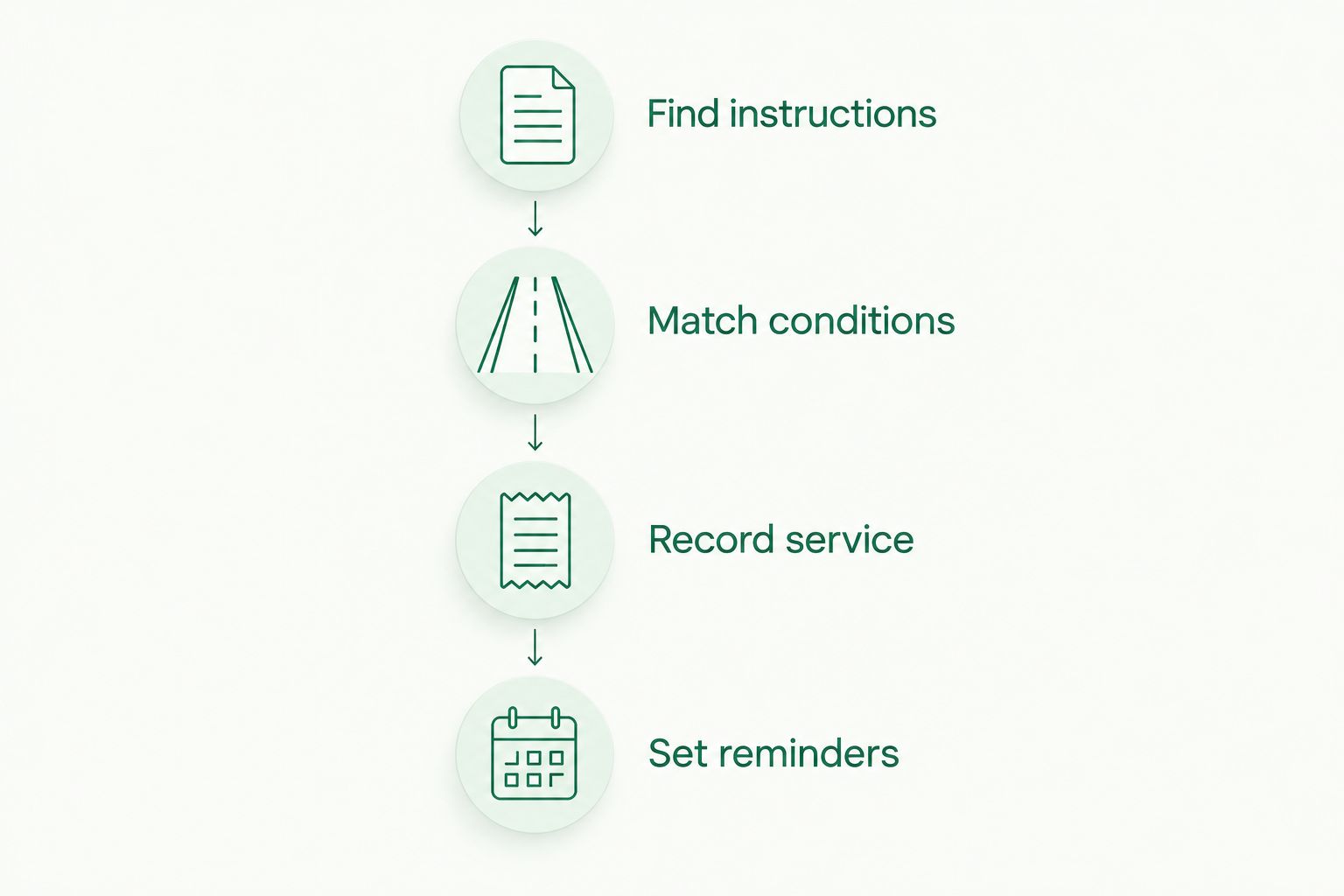
A reminder is most useful when it records a real maintenance requirement. When you set up maintenance reminders, keep the due date tied to your vehicle's instructions and update the record after service; a calendar alert cannot account for an earlier mileage limit on its own.
For a shared vehicle, keep the record where everyone responsible for maintenance can find it. That avoids a familiar problem: each person assuming someone else knows when the last change happened.
Keep oil selection separate
The right oil and the right interval are connected, but they're not interchangeable decisions. Your owner's manual specifies the oil requirements; the maintenance schedule tells you when service is due under the applicable conditions.
The American Petroleum Institute's Motor Oil Guide explains viscosity grades and oil service classifications. Use that category information to understand the label, then use your vehicle manufacturer's instructions to determine what belongs in your engine. An oil being synthetic doesn't establish that it meets every required specification.
For your visit, bring or have access to the vehicle information and any maintenance instructions you're trying to clarify. At Bolton Oil Change, conventional and synthetic oil options are selected as appropriate for the vehicle, with oil filter replacement as part of the approved service offering.
If the issue is a warning light, suspected damage, or a mechanical problem, don't assume an oil change will resolve it. General mechanical diagnosis and engine repair are outside our service catalog.
How the schedules were ranked
The ranking puts the vehicle manufacturer's instructions ahead of regional shortcuts. Severe-service instructions come first when the conditions qualify; a manufacturer-directed monitor governs where specified; the normal schedule fits qualifying routine use; and the time limit prevents low-mileage vehicles from slipping through the cracks.
No single mileage figure wins across every engine, oil specification, and driving pattern. The best schedule is the applicable one, followed consistently.
FAQ
What should I do if I don’t know when the last oil change happened?
Look for a service receipt or another reliable maintenance record before choosing a next-due date. If you can’t establish the history, explain that uncertainty when arranging service rather than assuming the oil-life display proves the last change.
Can I use an oil change sticker instead of the owner’s manual?
Use the owner’s manual and applicable maintenance instructions to establish the interval. A sticker is a reminder; ask how its suggested date or mileage relates to your vehicle’s requirements if they differ.
Does dark engine oil mean I need an immediate oil change?
Oil color alone does not establish an oil change interval. Follow the maintenance schedule and respond separately to low oil level, warning messages, or other concerns according to the owner’s manual.
Should both vehicles in my household follow the same oil change schedule?
Only if each vehicle’s own requirements and driving conditions support that schedule. Track each vehicle separately rather than assuming a shared address or driver makes their requirements identical.
Does Bolton Oil Change require an appointment?
Bolton Oil Change does not require an appointment for oil change service. You can drive up to any of our three Lubbock locations during business hours and stay in your vehicle during service.
Does an oil change include general mechanical diagnosis?
An oil change at our business is not general mechanical diagnosis or repair. Our services focus on oil changes and closely related maintenance; engine, transmission, brake, and other mechanical repairs are outside that scope.
One last thing
Before your next visit, take a photo of the maintenance instructions that apply to your vehicle. Keep it with your latest service receipt. That gives you something more useful than a mileage number remembered from a different car.
When service is due, stop by a Bolton Oil Change location during business hours. No appointment is needed.
Related guides
- Synthetic oil change options for Lubbock drivers
- Oil change services for fleet vehicles
- Oil change options for high-mileage vehicles