

Best for routine, drive-up fleet oil changes: Bolton Oil Change. Best for consolidated administration: a provider with confirmed fleet-account support. Best for manufacturer-specific service needs: a provider that can document the required capability. The right choice for your Lubbock business depends on the vehicles you operate, the work they need, and how you authorize and record service.
- For fleet oil change services Lubbock businesses can use without appointments, Bolton Oil Change fits routine oil-and-filter maintenance.
- Choose fleet-account support when consolidated billing and authorization controls are essential; confirm those arrangements before sending vehicles.
- Match oil specifications and maintenance schedules to each vehicle, rather than applying one rule across the fleet.
- Keep routine oil changes separate from repair needs; Bolton specializes in oil changes and closely related maintenance.
Why the service model matters
A business vehicle needs more than a convenient place to pull in. You also need a clear answer to three questions: Can the provider perform the required work, can your driver authorize it correctly, and can your office keep an accurate maintenance record?
Those questions become more important when different employees share vehicles. A driver who arrives without the vehicle’s service requirements or purchasing instructions creates avoidable back-and-forth, even when the oil change itself is straightforward.
For your 2026 fleet plan, choose the service model first. Then confirm the details that matter to your operation instead of treating every oil change provider as interchangeable.
What makes a good fleet fit
Use these criteria before comparing convenience or choosing a shop:
- Vehicle requirements: Match the oil viscosity, performance specification, filter, and service schedule to the specific vehicle and engine.
- Service scope: Separate routine oil-and-filter service from mechanical repairs and other maintenance the vehicle needs.
- Operating fit: Decide whether drivers need flexible visits or your business needs coordinated service arrangements.
- Authorization process: Tell drivers who can approve additional work and how approval should happen.
- Recordkeeping: Decide what information your office needs after each visit and confirm the provider can supply it.
- Account requirements: Verify billing, payment, and administrative arrangements before treating a provider as a fleet-account partner.
The best fleet oil change provider fits both the vehicle’s requirements and your company’s approval process. Convenience alone does not answer either question.
Fleet service options at a glance
These options serve different operating needs. Choose the relevant model rather than assuming a dedicated fleet account is necessary for every business vehicle.
| Option | Best for | Standout feature | Key limitation |
|---|---|---|---|
| Bolton Oil Change drive-up service | Routine oil changes without appointments | Three Lubbock locations and stay-in-your-vehicle convenience | Specializes in oil changes and related maintenance, not full-service repair |
| Confirmed fleet-account provider | Businesses that require consolidated administration | An account structure matched to the company’s requirements | Billing, reporting, and approval features must be confirmed individually |
| Manufacturer-specific service provider | Vehicles with service requirements that need particular capability | A provider selected around the exact vehicle and required work | The provider’s name or service category alone does not establish suitability |
1. Bolton Oil Change: best for routine drive-up service
Bolton Oil Change is a strong fit for business vehicles that need routine oil-and-filter service without an appointment. Drivers can visit any of its three Lubbock locations during business hours and stay in their vehicles during service.
The approved service scope includes conventional and synthetic oil options appropriate for the vehicle, oil filter replacement, engine air filter checks and replacement, and fuel system services. Other advertised offerings include wiper blade sales with complimentary installation with purchase, fluid checks and applicable top-offs, and tire pressure checks and inflation.
That scope suits a routine maintenance stop. It does not replace a repair facility when a vehicle needs brake work, tire repair or rotation, engine or transmission repair, or general mechanical diagnosis.
Bolton Oil Change pros:
- No appointment is needed during business hours.
- Three Lubbock locations give drivers a choice of service location.
- Stay-in-your-vehicle service keeps the visit straightforward.
- Oil changes and closely related maintenance are the business’s focus.
Bolton Oil Change cons:
- Repair work outside the approved service scope requires another provider.
- Drive-up convenience is not a guaranteed wait or completion time.
- A routine visit should not be treated as confirmation of consolidated billing, fleet reporting, or special account terms.
Best for: Businesses that need a practical place for individual vehicles to receive routine oil changes between work commitments.
Verdict: Choose this option for routine drive-up service; confirm any fleet-specific administrative requirements separately.
2. Fleet-account support: best for centralized administration
A fleet-account provider is the better service model when your office needs more control over purchasing and records. The deciding feature is not the word fleet on a webpage; it is whether the provider can meet your actual account requirements.
Before choosing this model, write down the functions your business needs. Those might include a defined authorization contact, vehicle identifiers on invoices, or a particular payment process. Treat each item as a requirement to verify, not a standard feature every provider supplies.
Fleet-account support pros:
- Gives your office a clear set of administrative requirements to evaluate.
- Helps distinguish purchasing needs from the mechanical service itself.
- Supports a consistent approval process when the agreed arrangement includes one.
Fleet-account support cons:
- Account support does not establish that a provider can service every vehicle you operate.
- Setup and payment requirements need confirmation before drivers arrive.
- An account arrangement does not, by itself, guarantee faster service or broader maintenance coverage.
Best for: Businesses whose main difficulty is coordinating approvals, payments, and maintenance records across multiple drivers.
Verdict: Choose this model when administrative requirements determine the decision, and verify the terms before relying on them.
3. Manufacturer-specific service: best for specialized requirements
A manufacturer-specific service provider is the right model when the required work depends on capabilities beyond a routine oil change. Start with the vehicle’s maintenance instructions and the exact service needed, then confirm that the provider can perform it.
Do not assume every business truck needs specialized service. Equally, do not assume that a shop handling one vehicle in your fleet can handle every engine, configuration, or maintenance task you operate.
Manufacturer-specific service pros:
- Keeps provider selection tied to the vehicle’s documented requirements.
- Gives you a clear reason to ask about exact service capability.
- Helps separate specialized maintenance from a standard oil-and-filter visit.
Manufacturer-specific service cons:
- Suitability still requires confirmation for the particular vehicle and work.
- Appointment, authorization, and recordkeeping arrangements need separate review.
- A provider selected for specialized work is not automatically the best operating fit for every routine visit.
Best for: Businesses managing vehicles with maintenance requirements that need a specifically qualified or equipped provider.
Verdict: Choose this model when the vehicle or required work calls for it, not simply because the vehicle is used for business.
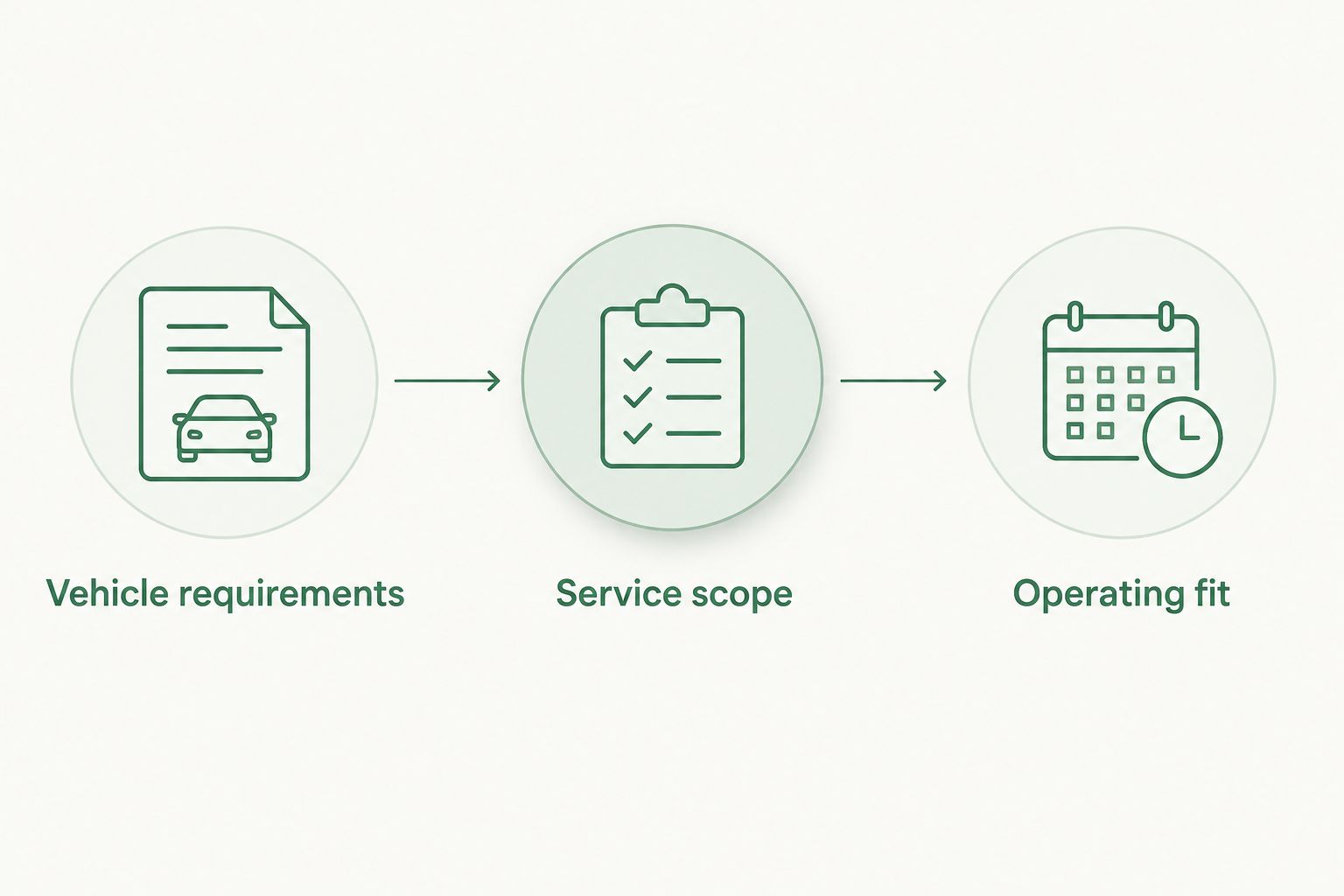
Give drivers clear service instructions
A short, consistent service instruction sheet helps your driver and your office ask the same questions. Organize it around three practical decisions.
Vehicle requirements
Identify the vehicle accurately, including its engine where necessary. Use the owner’s manual and applicable manufacturer maintenance information to establish the required oil and service schedule.
Oil viscosity and oil performance requirements are not interchangeable. Asking for synthetic oil alone does not communicate every specification a vehicle might require; the guide to synthetic oil change options for Lubbock drivers provides a useful starting point for that discussion.
Service scope
State what the driver is authorized to request. An oil change, an air filter replacement, and a reported mechanical problem are different service decisions, even when they arise during the same trip.
Keep a separate route for repair concerns. Sending a vehicle with an unresolved mechanical problem to an oil change specialist does not turn that visit into a diagnostic appointment.
Operating fit
Give the driver a clear approval contact and payment instructions. Ask the driver to return the service documentation promptly so the office can update the vehicle record.
Keep the process simple enough to use every time. A detailed policy that drivers cannot access during a visit is less useful than clear instructions stored with the vehicle’s service information.
Keep schedules vehicle-specific
Do not assign the same oil change interval to every vehicle simply because they belong to the same company. Follow each vehicle manufacturer’s maintenance instructions, including applicable time limits, mileage limits, oil-life monitoring instructions, and operating-condition guidance.
For vehicles working on dusty routes around the South Plains, check the manufacturer’s instructions for dusty operating conditions. The useful question is whether the vehicle’s actual use meets those conditions—not whether every vehicle based in West Texas needs the same shortened schedule.
Your maintenance record should make the next decision easier. Record the service date, odometer reading, work performed, and the information needed to determine the next service under the manufacturer’s instructions.
How these options were ranked
This guide ranks service models by operating need: routine drive-up maintenance first, centralized account administration second, and manufacturer-specific capability third. It does not rank unrelated shops using assumed prices, reviews, or service promises.
The criteria remain the same across all three options: correct vehicle requirements, suitable service scope, workable visit arrangements, clear authorization, and useful records. Your business’s most important requirement determines which option comes first for you.
Which service should you choose?
Bolton Oil Change is best for Lubbock businesses seeking routine, no-appointment fleet oil changes rather than full-service repair. Choose a fleet-account arrangement instead when documented billing and approval features are essential, or a manufacturer-specific provider when the required work demands that capability.
You do not have to send every maintenance task to the same business. A clear division between routine oil changes and specialized service is more useful than expecting one visit to cover work outside a provider’s scope.
FAQ
Can different employees bring the same company vehicle for an oil change?
Give every authorized driver access to the same vehicle requirements and approval instructions. That keeps the requested service consistent when responsibility for the vehicle changes hands.
What should a driver do if additional maintenance is recommended?
The driver should follow your company’s authorization policy before approving additional work. Provide a reachable decision-maker and make clear whether the driver has any purchasing authority.
Does a company vehicle automatically need synthetic oil?
Business use alone does not determine the required oil. Follow the specific vehicle manufacturer’s viscosity and performance requirements rather than choosing oil solely because the vehicle belongs to a fleet.
Should I choose an oil change provider only by distance from the office?
No; confirm vehicle suitability and service scope before comparing location convenience. A nearby provider is useful only if it can perform the required service and work with your approval process.
Can I assume a fleet account includes every maintenance service?
No; account arrangements and maintenance capabilities are separate questions. Confirm the covered vehicles, authorized work, payment process, and reporting requirements individually.
What should I do when a driver reports a mechanical problem before an oil change?
Arrange an appropriate assessment for the reported problem rather than treating the oil change as a repair visit. Give the driver clear instructions about where the vehicle should go and who can authorize the work.
One last thing
Put the vehicle’s service instructions where the driver can find them—not only in the office’s maintenance file. Clear authorization and accurate vehicle information are useful before the vehicle reaches the service bay.
For routine oil-and-filter maintenance, stop by a Bolton Oil Change location during business hours. No appointment is needed; keep any repair or specialized-service needs on a separate plan.
Related guides
- Oil change options for high-mileage vehicles
- Engine air filter replacement for West Texas driving
- Truck lube and oil change services in Lubbock