
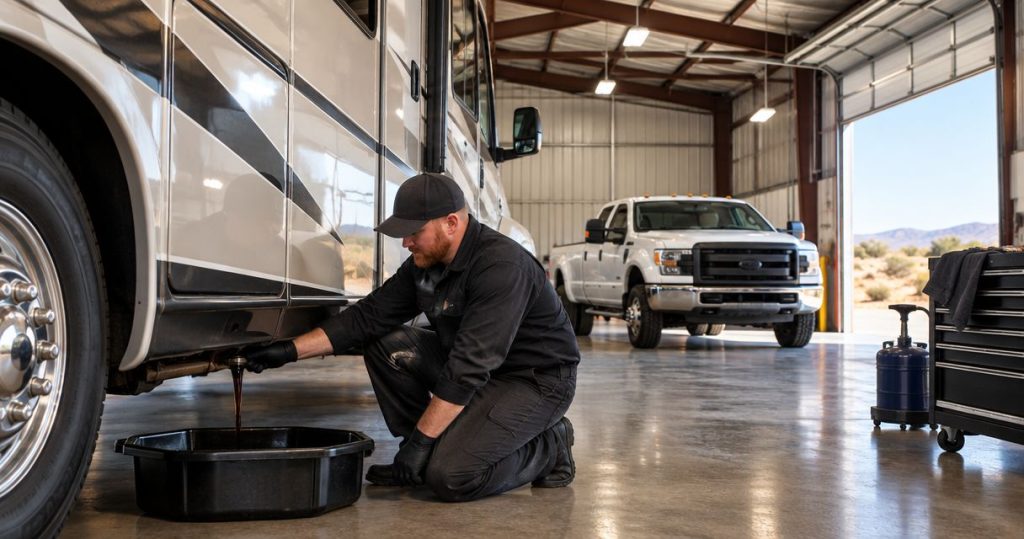
Best for routine work pickups: Bolton Oil Change, after confirming service capability for your exact truck. Best for motorhomes: a provider equipped for your RV’s chassis. Best for medium- and heavy-duty work trucks: a commercial truck service provider. The right oil change for RV and work trucks depends on the engine, vehicle dimensions, and work required—not a shop’s general promise of quick service.
- Choose an oil change for RV and work trucks by engine requirements, chassis access, and service scope.
- Bolton Oil Change fits routine work-pickup oil changes only after capability for the specific truck is confirmed.
- Motorhomes need chassis-qualified service; towing a travel trailer does not make the trailer an engine-service customer.
- Confirm the oil specification, filter, vehicle fit, and included work before making the trip.
Why vehicle fit comes first
An RV and a work truck can have very different service requirements, even when both use diesel fuel. A motorhome adds questions about chassis access and overall dimensions; a work truck adds questions about engine requirements, equipment, and how the vehicle is used.
Bolton Oil Change is best for routine work-pickup oil changes when the specific vehicle’s service requirements are confirmed. Our approved service list does not establish RV, commercial diesel, or heavy-truck capability, so don’t assume those vehicles can be serviced simply because we offer oil changes.
This guide compares service routes rather than naming unverified local competitors. Each recommendation has a separate job: routine pickup maintenance, motorhome engine service, or commercial-truck maintenance.
What makes the best service
Use these criteria before choosing where to take your vehicle:
- Engine requirements: The provider must use oil meeting the viscosity and performance specifications required for your particular engine, along with the correct filter.
- Physical access: Confirm that the vehicle’s height, width, length, weight, and service-access points suit the facility and its equipment.
- Service scope: An engine oil change is not the same as transmission service, chassis lubrication, generator maintenance, or mechanical repair.
- Driving conditions: Match maintenance to the manufacturer’s guidance for how you actually use the vehicle, including applicable towing, idling, or dusty-road schedules.
- Clear documentation: Ask for a receipt identifying the vehicle, mileage, oil, filter, and completed work. Keep that information with your maintenance records.
A provider that cannot confirm the first two requirements is not the right choice, regardless of how convenient the location looks.
Service options at a glance
| Service route | Best for | Main advantage | Key limitation |
|---|---|---|---|
| Bolton Oil Change | Routine oil changes for work pickups, after vehicle confirmation | Drive-up service without an appointment at three Lubbock locations | RV and heavy-truck capability is not established in the approved service information |
| Chassis-qualified motorhome provider | Motorhome engine oil and filter service | Service selection starts with the RV’s engine and chassis requirements | RV branding alone does not establish engine-service capability |
| Commercial truck service provider | Medium- and heavy-duty work trucks | A service route to evaluate for commercial chassis and operating requirements | Commercial-truck branding alone does not establish capability for your exact vehicle |
These are fit-based recommendations, not claims that every provider in a category offers the same equipment or services.
1. Bolton Oil Change: best for routine work pickups
Bolton Oil Change provides drive-up oil changes and closely related maintenance at three Lubbock locations. No appointment is needed during business hours, and customers can stay in their vehicles during service.
For a work pickup, start by confirming the exact vehicle and engine. Conventional and synthetic oil options are part of our approved service offering, but that does not establish compatibility with every pickup, diesel engine, or commercial configuration.
Bolton Oil Change pros:
- No appointment is needed for drive-up service during business hours.
- Oil changes and oil filter replacement are core services.
- Engine air filter checks and replacement are available within the approved service catalog.
- Stay-in-your-vehicle convenience keeps the visit focused on routine maintenance.
Bolton Oil Change limitations:
- RV, medium-duty, and heavy-duty service capability is not confirmed by the available company information.
- Brake repair, tire rotation, and engine or transmission repair are outside our service scope.
- Drive-up service is not a guarantee of an immediate start or a fixed completion time.
If you need a pickup oil change rather than a repair appointment, this is the appropriate service route to investigate first. Bring the engine details and oil requirements, especially if the truck has a diesel engine, an unusual configuration, or equipment that affects access.
Best for: A work-pickup owner who needs routine engine oil and filter service and has confirmed vehicle suitability.
Verdict: Buy this service after confirming the truck’s requirements; skip it for repairs outside the approved catalog.
2. Chassis-qualified service: best for motorhomes
For a motorhome, choose a provider that confirms it can service the exact chassis and engine underneath the living area. The RV manufacturer’s name is useful, but it is not enough on its own to identify the engine oil, filter, or service-access requirements.
Have the chassis information available when you contact a provider. For a diesel pusher, specifically confirm that the provider handles that engine arrangement rather than assuming general RV service includes it.
Chassis-qualified motorhome service pros:
- Engine and chassis details guide the service request from the beginning.
- Vehicle dimensions can be checked before you drive to the facility.
- The work order can separate engine maintenance from house-system maintenance.
Chassis-qualified motorhome service limitations:
- A business that repairs RV interiors or appliances is not automatically an engine-service provider.
- Generator maintenance is a separate service question, even when the motorhome engine is being serviced.
- A suitable provider still needs to confirm access, equipment, and the requested work for your particular RV.
Ask a direct question: can the facility perform the engine oil and filter change on this chassis, with this engine, at these dimensions? That produces a more useful answer than asking whether the business “works on RVs.”
Best for: Motorhome owners who need engine oil service matched to a specific chassis, including vehicles with unusual access requirements.
Verdict: Buy from a provider that confirms the chassis and engine; skip a generic RV-service answer that leaves those details unresolved.
3. Commercial truck service: best for heavier work vehicles
For a medium- or heavy-duty work truck, start with a commercial truck service provider and verify the exact vehicle. A utility body, box body, or other work configuration can affect facility access, so the truck’s badge alone is not a complete description.
Separate the engine oil change from any additional maintenance you need. If the truck also needs chassis lubrication, transmission service, or repairs, ask which tasks the provider actually performs rather than assuming they come with an oil change.
Commercial truck service pros:
- The service inquiry can address the complete commercial vehicle configuration.
- Engine oil service can be specified separately from other maintenance tasks.
- Maintenance records can identify work for an individual truck within a business fleet.
Commercial truck service limitations:
- The category name does not prove a facility can handle every truck size or engine.
- An oil change does not automatically include every chassis lubrication point or drivetrain fluid service.
- Fleet scheduling, account arrangements, and additional services require separate confirmation.
For several vehicles, give the provider a vehicle-by-vehicle list. Identical-looking trucks can have different engines, model-year requirements, or maintenance histories. Our guide to oil change services for fleet vehicles in Lubbock covers the fleet-service decision in more detail.
Best for: Businesses operating work vehicles whose size, chassis, or maintenance needs call for confirmed commercial-truck capability.
Verdict: Buy after the provider confirms each truck’s requirements; skip assumptions based on the words commercial service.
Confirm these details before visiting
A short preparation step prevents an unnecessary trip. Put the following information together before asking whether a provider can service your RV or work truck.
Vehicle identity
Provide the year, make, model, and engine. For a motorhome, add the chassis manufacturer and chassis details; the name on the living area does not always identify the underlying powertrain.
Oil requirements
Use the owner’s manual or engine manufacturer’s maintenance information to identify the required viscosity, performance specification, and oil quantity. Synthetic oil is not a substitute for meeting the required specification.
Vehicle dimensions
Provide the vehicle’s dimensions and relevant weight information when facility fit is uncertain. Mention roof equipment, a utility body, or anything else that changes clearance or access.
Requested work
State exactly what you want done: engine oil and filter replacement, an engine air filter check, or another specific task. Keep generator service, repair concerns, and other fluid services separate so nothing is assumed.
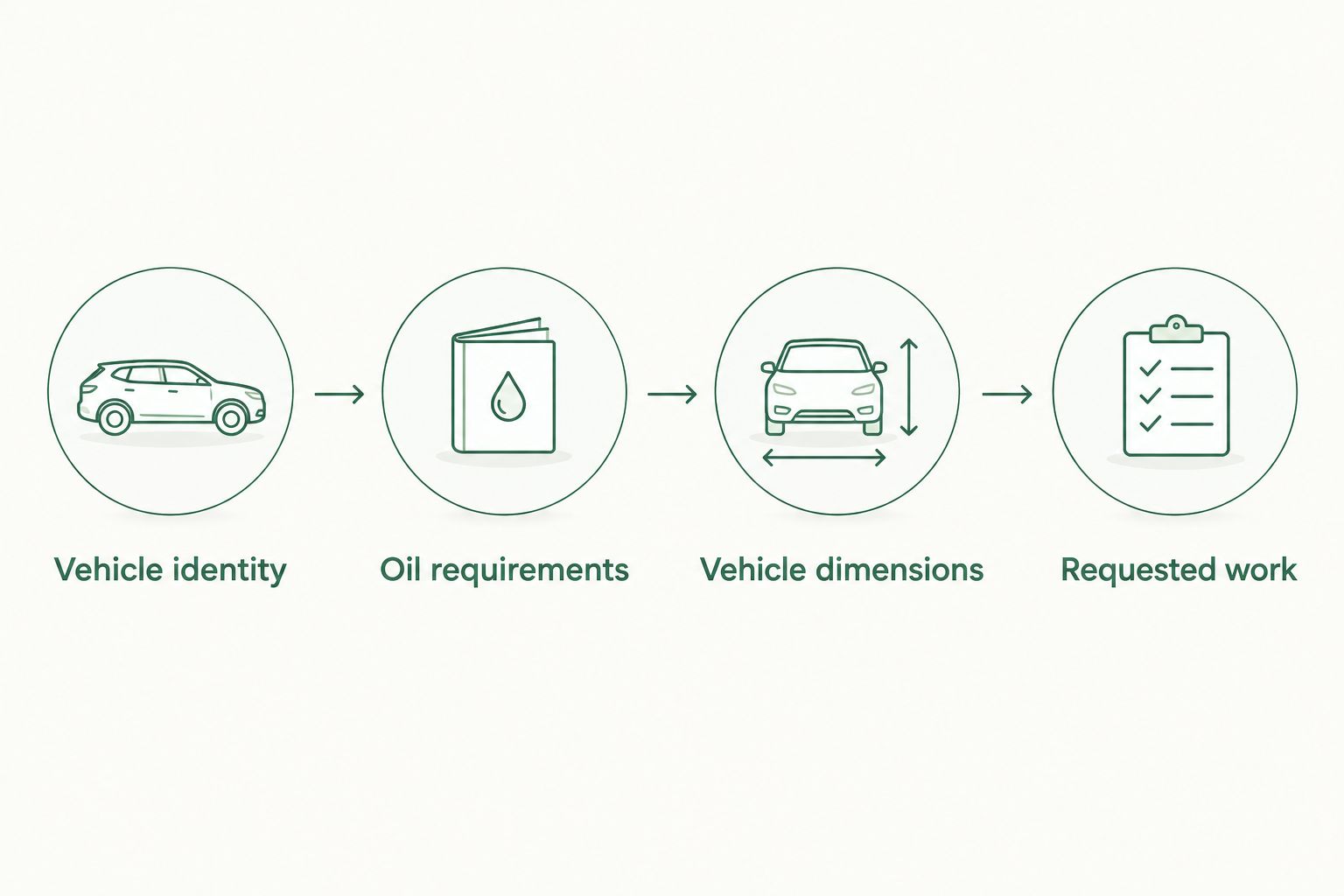
The same checklist helps if someone else normally handles your maintenance. A written vehicle record is easier to use than trying to remember the engine details while you are already on the road.
Match maintenance to actual use
West Texas dust, towing, and jobsite use make the manufacturer’s operating-condition guidance relevant. Check whether your particular driving falls under a severe-service or special-operating-conditions schedule; don’t automatically apply a shorter interval to every vehicle in the region.
Time matters alongside mileage when the manufacturer specifies both. An RV that spends long periods parked and a work truck that accumulates miles quickly need schedules based on their own manuals, not the same rule of thumb.
For vehicles with an oil-life monitor, follow the manufacturer’s instructions for using the system and any stated time limits. Keep records of the completed service rather than treating a reset display as the maintenance record itself.
How these recommendations were ranked
The ranking starts with service fit: engine requirements, physical access, and the requested work. Convenience comes after those requirements are satisfied.
Bolton’s recommendation is limited to its approved oil-change offering and requires confirmation for the specific work pickup. The other recommendations identify provider categories to evaluate; they do not claim that any unnamed business has been inspected, tested, or verified.
FAQ
Does my travel trailer need an engine oil change?
A towable travel trailer does not have a propulsion engine to service; the tow vehicle needs its own engine maintenance. If the trailer has a generator, follow that generator manufacturer’s separate maintenance instructions.
Can my RV generator be serviced with the motorhome engine?
Generator service is a separate task that you must confirm with the provider. The generator has its own maintenance requirements, and a motorhome engine oil change does not establish that generator service is included.
Should I disconnect my trailer before taking my pickup for an oil change?
Ask the provider before arriving with a trailer attached. Facility access and space requirements determine whether the combination can enter safely or whether you need to arrive with the pickup alone.
Can I use the same oil in every truck in my fleet?
Only use the same oil when it meets each engine’s required viscosity and performance specifications. Check every vehicle rather than assuming a shared make or similar appearance means identical requirements.
What should I keep on my oil-change receipt?
Keep the service date, vehicle identification, mileage, oil specification, filter information, and description of completed work. Clear records help you track maintenance without relying on memory.
Will an oil change fix an oil-pressure warning?
Do not treat an oil-pressure warning as a routine oil-change reminder. Follow the vehicle manufacturer’s immediate instructions and seek appropriate mechanical diagnosis; Bolton Oil Change does not offer general mechanical diagnostics or engine repair.
Choose the service that fits
For a motorhome, confirm the chassis first. For a heavier commercial truck, confirm equipment and service scope. For a routine work pickup, confirm the engine requirements before choosing a drive-up oil change. That order keeps convenience from taking priority over suitability.
One final distinction helps: the living area and the chassis of a motorhome can come with separate maintenance information. Keep both available, but use the engine and chassis guidance when arranging engine oil service.
If your work pickup is suitable for our service, stop by one of our three Lubbock locations during business hours. No appointment is needed.
Related guides
- Truck lube and oil change services in Lubbock
- Quick-lube versus full-service oil changes
- Engine air filter replacement for West Texas driving