

Best overall when service is due: Bolton Oil Change for an oil-and-filter change matched to your vehicle. Best when service isn’t due: check your maintenance schedule rather than change oil just because it’s winter; for winter oil change prep in West Texas, your vehicle’s requirements come first.
- Bolton Oil Change is best for drivers whose winter preparation includes a due oil-and-filter change.
- For winter oil change prep in West Texas, follow your vehicle’s oil specification—not a seasonal guess.
- Check your maintenance schedule before replacing oil that isn’t due for service.
- Treat engine air filters and windshield wipers as separate maintenance decisions, not automatic winter replacements.
Why the distinction matters
A cold forecast doesn’t tell you which oil your engine needs. Your owner’s manual specifies the viscosity, performance requirements, and maintenance guidance that should drive the decision.
For your 2026 winter preparation, separate three questions: Is the oil change due? Does the current oil meet the vehicle’s requirements? Is another maintenance item actually worn or dirty? That approach gives you a useful plan without turning a seasonal visit into a collection of unnecessary replacements.
West Texas dust also deserves attention, but it doesn’t make every vehicle’s maintenance schedule identical. Follow the manufacturer’s instructions for your actual driving conditions rather than treating your ZIP code as a service interval.
What makes good winter preparation
These criteria determine which option belongs first on your list:
- Correct specification: Use the viscosity and performance specification required for your engine.
- Service timing: Check mileage, elapsed time, and the vehicle’s oil-life instructions where applicable.
- Observed condition: Replace an air filter or wiper blade because its condition warrants it, not because a package includes it.
- Driving conditions: Consult the manufacturer’s guidance for repeated short trips, dust, towing, or other conditions that apply to you.
- Clear service boundaries: Separate routine oil-change maintenance from mechanical problems that need a repair provider.
The best 2026 winter plan is the one that addresses an actual need. A longer service list isn’t automatically a better one.
Winter prep at a glance
| Rank and option | Best for | Standout benefit | Key limitation |
|---|---|---|---|
| 1. Vehicle-matched oil-and-filter change | Drivers whose oil service is due | Addresses scheduled engine lubrication maintenance | Doesn’t diagnose or repair mechanical problems |
| 2. Maintenance schedule review | Drivers whose oil service isn’t due | Avoids replacing oil solely because the season changes | Depends on accurate records and manufacturer instructions |
| 3. Engine air filter check | Drivers with dust exposure or a filter due for inspection | Bases replacement on condition and maintenance guidance | Doesn’t replace an oil change or correct engine faults |
| 4. Wiper blade check and replacement | Drivers with streaking, damaged, or poorly clearing blades | Addresses a specific visibility problem | Doesn’t repair washer pumps, wiper motors, or damaged glass |
1. Bolton Oil Change: best for due oil service
If your oil change is due, make that the first maintenance task rather than looking for a special “winter oil.” Bolton Oil Change offers conventional and synthetic oil options appropriate for the vehicle, along with oil filter replacement.
You can drive up without an appointment during business hours and stay in your vehicle during service. There are three Lubbock locations, so you can choose the one that fits your route without arranging an appointment-based repair visit.
Vehicle-matched oil change pros:
- Addresses an oil-and-filter change that is already due.
- Keeps the decision centered on your vehicle’s oil requirements.
- Offers drive-up, stay-in-your-vehicle convenience.
- Allows you to ask about related checks without assuming every item needs replacement.
Vehicle-matched oil change cons:
- An oil change does not diagnose an unexplained warning light, leak, or starting problem.
- Drive-up service does not mean a guaranteed wait or completion time.
Read the oil grade correctly
The numbers on an oil label describe a viscosity grade, not a quality ranking. Under SAE J300, the portion with the W relates to low-temperature performance; the second number describes the high-temperature viscosity grade.
For example, 0W-20 and 5W-30 are different grades, not interchangeable winter recommendations. A lower first number isn’t permission to change what your engine requires. Use an alternate grade only when the vehicle manufacturer allows it for the applicable conditions.
Also check the required performance specification. Matching the viscosity alone doesn’t establish that an oil meets every requirement in your owner’s manual. SAE J300 explains viscosity classification; the American Petroleum Institute’s motor oil guidance explains service categories and oil labeling.
Best for: Drivers whose scheduled oil service is due before winter travel or regular cold-weather driving.
Verdict: Buy the due oil-and-filter service; skip an unsupported seasonal grade change.
2. Schedule review: best when service isn’t due
If your oil service isn’t due and the oil meets your vehicle’s requirements, winter alone isn’t a reason to replace it. Review your last service record and the manufacturer’s maintenance instructions before authorizing another change.
Check both time and mileage requirements. If your vehicle uses an oil-life monitor, follow the owner’s manual for interpreting it, including any separate time limit or operating-condition instructions.
Schedule review pros:
- Separates a real service need from a calendar-based assumption.
- Helps you plan maintenance before a trip instead of guessing.
- Keeps manufacturer instructions ahead of generic interval advice.
Schedule review cons:
- Incomplete service records make the decision less certain.
- A schedule review cannot establish the cause of a leak, warning light, or unusual engine noise.
Check your actual driving pattern
Some manufacturers provide different maintenance guidance for conditions such as frequent short trips or dusty driving. Check the definitions in your own manual; don’t assume every West Texas vehicle falls into the same category.
A useful review compares your driving with those definitions and checks the associated instructions. Our guide to oil change intervals by West Texas driving conditions provides a related starting point, but your vehicle’s requirements remain the deciding reference.
If you can’t confirm the last service, say so plainly when discussing your next change. An uncertain record is a reason to establish an informed maintenance plan—not to invent a previous interval.
Best for: Drivers with recent, documented oil service who want to prepare for winter without duplicating maintenance.
Verdict: Hold the extra oil change when the manufacturer’s instructions show it isn’t due.
3. Air filter check: best after dusty driving
An engine air filter check belongs on your list when the manufacturer calls for inspection or your driving includes dusty conditions. The useful question is whether the filter needs attention, not whether every winter visit should include a replacement.
An engine air filter and an oil filter do different jobs. Replacing one does not replace the maintenance requirement for the other, and an air filter change isn’t a substitute for investigating an engine problem.
Engine air filter check pros:
- Focuses attention on an item relevant to dusty driving.
- Allows replacement to follow condition and manufacturer guidance.
- Fits within the approved closely related maintenance offered during an oil-change visit.
Engine air filter check cons:
- Dust exposure alone doesn’t establish that replacement is necessary today.
- A replacement filter is not a general cure for rough running or warning lights.
Ask what the check found and why replacement is recommended. That keeps the conversation specific and gives you something more useful than a blanket seasonal recommendation.
If this is your main concern, read the guide to engine air filter replacement for West Texas driving before your visit.
Best for: Drivers whose maintenance guidance calls for an air filter check, especially when their routes include dust exposure.
Verdict: Buy a replacement when inspection and vehicle guidance support it; skip automatic seasonal replacement.
4. Wiper check: best for poor clearing
Wiper blades deserve a separate decision because their job is visibility, not engine maintenance. Look for damaged rubber and poor clearing, including persistent streaking after the windshield and blade edges are clean.
You don’t need to replace working blades simply because you’re scheduling an oil change. You do need to address blades that no longer clear properly before relying on them in winter weather.
Wiper blade replacement pros:
- Addresses an observable visibility problem.
- Can be considered separately from oil service timing.
- Includes complimentary installation with a blade purchase at Bolton.
Wiper blade replacement cons:
- New blades won’t repair a faulty washer pump or wiper motor.
- Replacement is unnecessary when the existing blades remain in good condition and clear properly.
Don’t use the wipers to force blades free from ice on the windshield. Clear the glass and free the blades before operating them, following your vehicle’s instructions.
Best for: Drivers with worn, damaged, or poorly clearing blades—not everyone coming in for winter oil service.
Verdict: Buy blades for a clearing problem; hold replacement when the existing blades work properly.
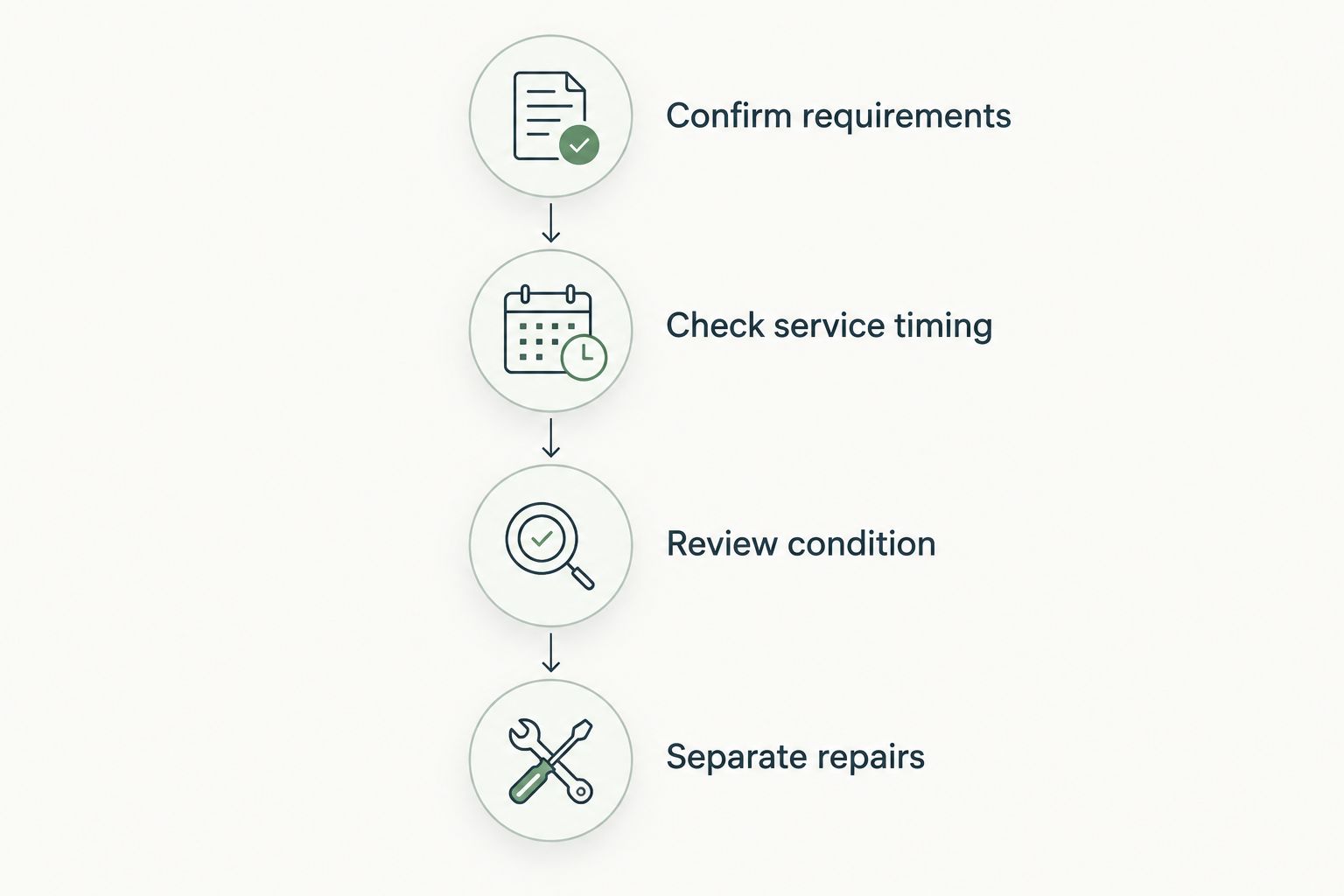
Put the checks in order
For a 2026 winter visit, start with the vehicle’s requirements, decide which service is due, and then consider condition-based items. This order keeps a useful check from becoming an automatic purchase.
- Confirm requirements: Find the specified oil grade and performance requirements.
- Check service timing: Review your service record and maintenance instructions.
- Review condition: Consider the engine air filter and wiper blades on their own merits.
- Separate repairs: Take mechanical problems to a provider equipped for that work.
Tire pressure also deserves attention as temperatures change. Check pressure against the vehicle manufacturer’s recommendation, generally shown on the tire information placard, rather than using the tire sidewall’s maximum pressure as your target. Follow the vehicle’s instructions for checking cold tire pressure.
Fluid checks and applicable top-offs, plus tire pressure checks and inflation, are among our advertised offerings. Those checks are not tire repair, tire rotation, cooling-system repair, or a complete winter mechanical inspection.
How these options were ranked
This 2026 guide ranks actions by the need they answer: due oil maintenance first, avoiding unnecessary repeat service second, and condition-based air filter and wiper decisions next. It does not rank competing businesses or claim that one oil grade suits every vehicle.
The technical references are SAE J300 for viscosity classification, API motor oil labeling guidance, and your vehicle manufacturer’s owner’s manual. For the actual oil choice and maintenance timing, the manual is the vehicle-specific reference.
Which option should you choose?
Choose the due oil-and-filter change if your records and maintenance instructions call for it. Otherwise, check the schedule and address only the condition-based items that need attention. That is a more useful default than purchasing a winter package without knowing what it includes.
Bring your service information and any questions about the specified oil. If your concern is an oil-pressure warning, overheating, an unexplained leak, or a mechanical fault, seek appropriate repair assistance rather than treating an ordinary oil change as the diagnosis.
FAQ
Does the W in motor oil mean weight?
No. The W identifies the winter portion of an SAE viscosity grade, which relates to specified low-temperature performance tests. It is not a separate measure of oil quality.
Does full synthetic oil let me ignore the change schedule?
No. Follow your vehicle manufacturer’s maintenance instructions even when using full synthetic oil. The oil must meet the required specifications, and the service timing still applies.
Does an oil-life display tell me the oil level?
An oil-life display is not a substitute for checking oil level according to your owner’s manual. Oil-life information and oil quantity answer different questions.
Should I use the tire sidewall pressure for winter driving?
Use the vehicle manufacturer’s recommended tire pressure, not the tire sidewall’s maximum pressure as your target. Follow the vehicle’s instructions for checking cold tire pressure.
Can I get an oil change and have a mechanical warning diagnosed at the same visit?
Bolton Oil Change specializes in oil changes and closely related maintenance, not general mechanical diagnostics or repair. A mechanical warning needs attention from an appropriate repair provider.
Do I need an oil change coupon before stopping by?
No coupon is needed. Our approach is everyday low prices, without requiring a promotional code or printed coupon.
One last thing
The oil grade on the filler cap is useful, but it isn’t the whole specification. Before your next visit, find the oil requirements in your owner’s manual and keep a copy with your service records.
For your 2026 winter preparation, bring that information to Bolton Oil Change when service is due. Stop by one of our three Lubbock locations during business hours; no appointment is needed.
Related guides