
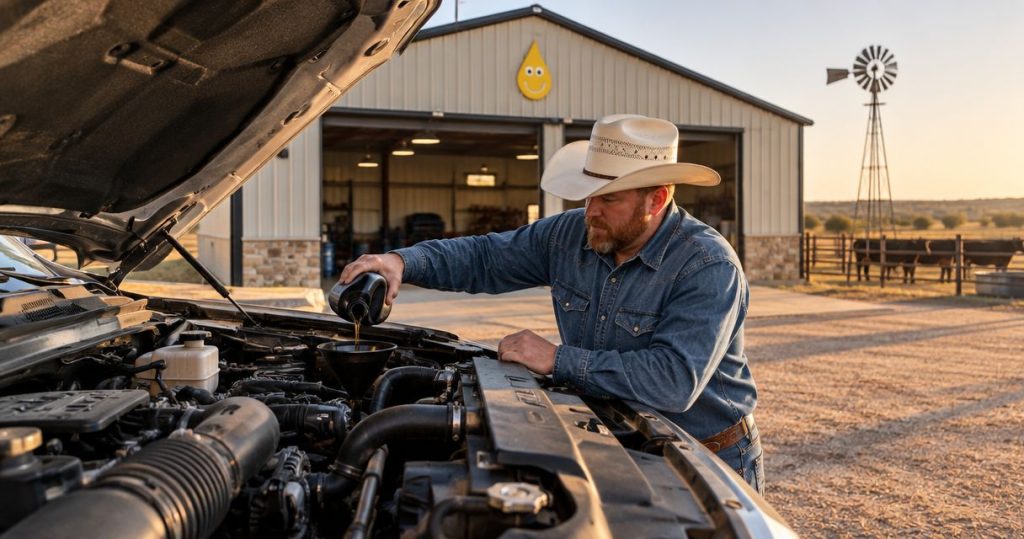
Oil changes for West Texas ranchers mean matching each working vehicle’s oil and service schedule to its engine requirements and actual use. Your 2026 maintenance plan should account for dusty roads, trailer work, idling, and short trips where the vehicle manufacturer identifies those conditions, rather than treating every ranch pickup like a highway commuter.
- Oil changes for ranchers in West Texas start with the vehicle manufacturer’s oil specification and maintenance schedule.
- Bolton Oil Change fits ranchers needing drive-up oil changes in Lubbock, not mechanical repairs.
- Record towing, dust exposure, and idling so you can select the manufacturer’s applicable maintenance schedule.
- Keep separate service records for each ranch vehicle; one truck’s interval isn’t a fleet-wide rule.
Why ranch use changes planning
A ranch pickup’s odometer doesn’t describe its whole working day. Driving to town, pulling a trailer, traveling unpaved roads, and spending time idling are different operating conditions. The useful question is not simply how far you drove, but which maintenance instructions apply to that work.
Use the manufacturer’s schedule for the conditions your vehicle actually experiences. Don’t shorten or extend an interval based only on a neighbor’s truck, a familiar oil brand, or the fact that the engine still sounds normal.
For trips into Lubbock, Bolton Oil Change offers no-appointment, drive-up oil changes at three locations during business hours. That helps with planning, but choosing the correct oil and identifying any separate repair needs still come first.
Build your ranch service plan
Identify each vehicle’s requirements
Start with the owner’s manual, maintenance guide, and previous service records. Match the guidance to the actual engine, not just the truck’s badge or model name. Different engines within the same vehicle line can have different requirements.
Find both the viscosity grade and the required oil performance specification or manufacturer approval. A bottle’s viscosity marking alone doesn’t establish that the oil meets every requirement for your engine. If the paperwork is unclear, resolve that before choosing the oil.
This is especially useful when a ranch has acquired used vehicles with incomplete records. An old windshield sticker shows a previous recommendation; it doesn’t replace the manufacturer’s instructions.
- Record the vehicle’s year, model, and engine.
- Find the required oil viscosity and specification.
- Confirm the oil capacity and correct filter application.
- Keep the maintenance guide accessible to anyone arranging service.
Match the schedule to work
Read the operating-condition descriptions in the manufacturer’s maintenance guide. Dusty driving, towing, extensive idling, and repeated short trips are reasons to check for special instructions, not permission to invent a universal “ranch interval.”
Some manufacturers provide separate maintenance guidance for particular uses. Others rely on an oil-life monitoring system with additional instructions or limits. Follow the arrangement specified for your vehicle, including any time limit that applies alongside mileage.
For your 2026 plan, describe the truck’s actual work before picking a service date. The guide to oil change intervals by West Texas driving conditions provides related reading, but the vehicle manufacturer remains the authority for your schedule.
- Note regular trailer use and loaded operation.
- Identify frequent unpaved or dusty-road driving.
- Record substantial idling and repeated short trips.
- Read the applicable maintenance conditions and exceptions.
- Use engine-hour guidance only when the manufacturer provides it.
Explain the job before service
You don’t need special software to prepare for an oil change. A note on your phone or the maintenance page from your manual is enough to communicate the required oil and the work the truck performs.
Bolton Oil Change provides the drive-up service option when you want someone else to handle the oil and filter change. Explain the vehicle’s requirements and mention concerns before work begins. Don’t assume that a routine oil change also addresses a warning light, leak, or mechanical symptom.
Ask about compatibility before bringing specialized equipment or a vehicle with unusual service requirements. The approved service offering does not establish suitability for every diesel engine, commercial vehicle, or piece of ranch machinery.
- Bring the vehicle’s oil requirements and service history.
- Explain towing, dust exposure, or extended idling.
- Mention any warning lights or unusual symptoms.
- Ask whether the location can service the specific vehicle.
- Confirm what work is included before authorizing additions.
Separate checks from repair needs
An oil change is a good occasion to keep related maintenance from being overlooked. It is not a substitute for mechanical diagnosis, and it shouldn’t turn into an undefined package of services.
For ranch vehicles traveling dusty roads, engine air filter inspection deserves attention under the manufacturer’s guidance. Don’t invent a replacement interval based only on the season. See the guide to engine air filter replacement for West Texas vehicles for that separate maintenance topic.
The distinction matters with tires, too. A pressure check and inflation are not tire repair, rotation, or replacement. Likewise, checking a fluid level does not diagnose why that level has changed.
- Ask about an engine air filter check.
- Follow the vehicle’s filter maintenance instructions.
- Distinguish tire inflation from tire repair or rotation.
- Ask which fluid checks and top-offs apply.
- Take leaks, braking concerns, and mechanical symptoms to a repair provider.
Keep a usable service record
A shared truck needs a shared record. Keep a paper log in the vehicle, a spreadsheet, or a phone note that everyone responsible for maintenance can access. The best format is the one your ranch will actually maintain.
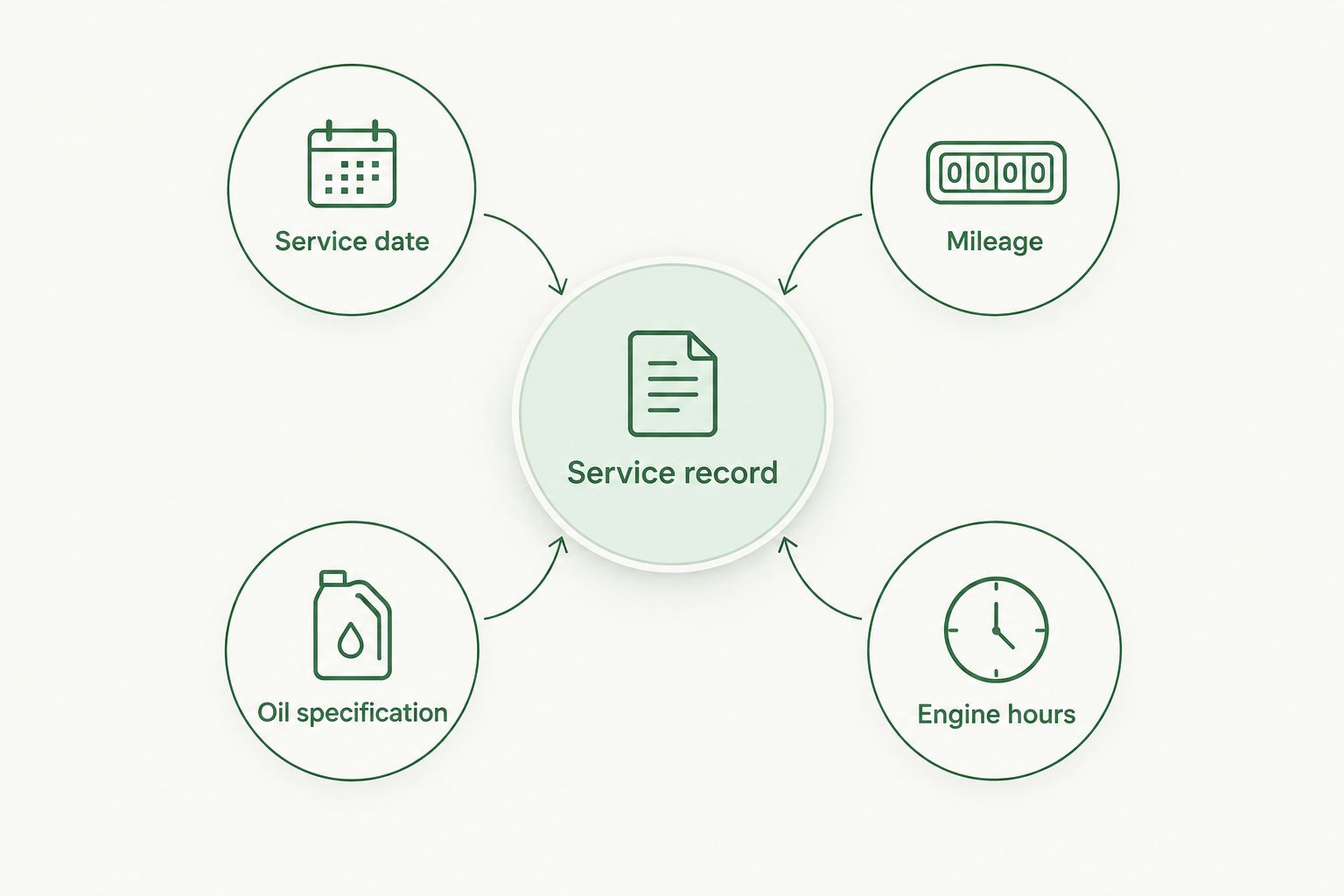
Your 2026 service record should identify what was done, when it was done, and what makes the next service due. Mileage alone leaves out useful context when the manufacturer also specifies elapsed time or engine-hour guidance.
Keep the receipt as well as the reminder. If the next driver only sees a sticker, that driver still needs access to the oil specification, previous work, and any concern that requires follow-up elsewhere.
- Service date: Record when the work was completed.
- Mileage: Record the odometer reading at service.
- Oil specification: Keep the oil details with the receipt.
- Engine hours: Record them when relevant to manufacturer guidance.
- Next service: Note the applicable mileage, time, or monitor instruction.
A simple record connects the oil requirement with the vehicle’s use. It also prevents several drivers from each assuming someone else arranged the next visit.
Arrange service around ranch work
Check the maintenance record before a demanding stretch of work, not just when you happen to notice the reminder. That gives you time to arrange due maintenance and address separate repair concerns without treating them as the same job.
Use a planned trip into Lubbock when the timing fits the vehicle’s schedule. Drive-up service removes the appointment requirement, but it does not guarantee an immediate bay or a fixed completion time. Leave room in your day rather than building a tight livestock or delivery schedule around an assumed wait.
For multiple vehicles, stagger visits according to each vehicle’s due date. Servicing every truck together is simple administratively, but each still needs its own oil selection and maintenance decision.
- Check due dates before busy work periods.
- Review current location hours before leaving.
- Allow time for the visit without assuming no wait.
- Arrange separate repair work when necessary.
- Update the log before handing the vehicle to another driver.
Compare your service options
Choose an oil-change provider for oil changes and a repair provider for repair needs. The right choice depends on the job, your equipment, and the vehicle’s requirements. Convenience alone doesn’t establish technical suitability.
These options describe service approaches, not a ranking of local businesses. For 2026 planning, compare the work you need with the scope each provider actually confirms.
| Option | Best for | Main advantage | Key limitation |
|---|---|---|---|
| Do-it-yourself oil change | Owners with the equipment, knowledge, and suitable workspace | You control the work and scheduling | You handle safe access, correct materials, cleanup, and used-oil disposal |
| Bolton Oil Change | Ranchers needing drive-up oil changes in Lubbock | No appointment needed; stay in your vehicle during service | Not a mechanical repair shop; confirm suitability for your particular vehicle |
| Qualified repair shop | Vehicles needing diagnosis or repairs alongside maintenance | You can arrange the repair work the vehicle needs | Confirm service scope and scheduling requirements directly |
A do-it-yourself change makes sense only when you can follow the vehicle’s procedure safely. Use the manufacturer’s lifting and support instructions, never rely on a jack alone, and arrange proper used-oil disposal. Don’t turn a maintenance task into a safety risk to avoid a trip.
A repair shop is the appropriate route when the main concern is a mechanical problem. An oil change does not establish why an engine is making noise or why a warning light appeared.
Mistakes that complicate ranch maintenance
Giving every truck one interval
A lightly used pickup and a regularly towing work truck don’t automatically belong on the same schedule. Maintain a separate record for each vehicle. Match each one to its manufacturer’s instructions and actual operating conditions.
Choosing oil by weather alone
West Texas heat is not a reason to disregard the specified viscosity or approval. Start with the manufacturer’s requirements, including any temperature-related guidance in the manual. Don’t substitute a different oil simply because it sounds better suited to summer.
Treating a top-off as service
Adding oil to correct the level is not the same as changing the oil and filter. Keep level checks and scheduled service as separate tasks. An unexplained change in oil consumption or level calls for appropriate assessment, not repeated assumptions.
Assuming the entire ranch fleet fits
An oil-change offering for road vehicles doesn’t establish support for tractors, hydraulic systems, heavy equipment, or every diesel application. Confirm the specific vehicle before traveling. Arrange machinery maintenance with a provider qualified for that equipment.
FAQ
Can I bring several ranch pickups without setting up a fleet account?
Bolton Oil Change offers no-appointment service, but the approved information does not establish fleet-account terms or arrangements for multiple vehicles arriving together. Ask the location about your particular plan before bringing several trucks.
Does an oil change include greasing every fitting on my truck?
Do not assume chassis lubrication is included in an oil change. Bolton Oil Change’s approved service list does not advertise that work; check your vehicle’s maintenance requirements and arrange it with an appropriate provider.
Can I request a particular oil brand for my ranch truck?
Ask the location directly about oil brands and whether an option meets your engine’s requirements. A required specification matters more than assuming a familiar brand or product is offered.
Should I reset the oil-life monitor after adding oil?
Do not reset the oil-life monitor simply because you added oil. Follow the vehicle manufacturer’s reset instructions after the specified service so the reminder continues to reflect the maintenance performed.
What should I do if the oil-pressure warning comes on while working?
Stop safely and follow the owner’s manual immediately rather than treating an oil-pressure warning as a routine oil-change reminder. Arrange appropriate assistance; do not continue a trip into town just to reach an oil-change location.
Can an oil-change receipt replace my manufacturer’s maintenance guide?
No. Keep receipts as evidence of the work performed, but use the manufacturer’s guide to determine required maintenance and applicable conditions. The receipt and the guide serve different purposes.
One last thing
Before your next service visit, check who receives the maintenance reminder. A truck shared by several people needs one clearly assigned person to keep the record current; otherwise, a reminder on someone else’s phone does little good.
Save the vehicle’s oil requirements beside that reminder for the rest of 2026. When the service is due, bring those details to Bolton Oil Change during business hours, and keep any separate repair concerns on their own list.
Related guides