

Skipping an oil change for too long lets oil deteriorate and contaminants accumulate, reducing protection against engine wear. If the engine also runs low on oil or loses oil pressure, serious damage can follow. An overdue oil change does not automatically mean your engine is ruined, but it does mean you should check for warning signs and arrange the right service rather than keep postponing it.
- What happens if you skip an oil change depends on oil condition, oil level, driving conditions, and the vehicle’s requirements.
- An oil-pressure warning while the engine runs calls for stopping safely and shutting the engine off.
- Adding oil corrects a low level; it does not replace an overdue oil and filter change.
- Bolton Oil offers drive-up oil changes, not engine diagnostics or repairs.
What happens if you skip an oil change for too long?
Engine oil lubricates moving parts, helps carry heat away, and keeps contaminants suspended until the oil is drained or particles are captured by the filter. With continued use, heat, oxidation, and contamination change the oil’s condition. Its additives also become depleted, weakening the protection the engine depends on.
If your vehicle is overdue but running normally, Bolton Oil provides oil and filter changes without an appointment. Warning lights, unusual engine noises, or a substantial leak require a different response than an ordinary maintenance visit.
| What you notice | What it means | What to do |
|---|---|---|
| Oil service reminder, with no other symptoms | Scheduled maintenance is due; the reminder alone does not establish engine damage | Check the manufacturer’s instructions and arrange an oil change promptly |
| Oil below the specified level | The engine does not have its specified oil quantity | Follow the manual’s checking and filling instructions; investigate recurring oil loss |
| Oil-pressure warning while the engine runs | Lubrication pressure needs immediate attention | Stop safely, shut off the engine, and follow the manual’s emergency instructions |
| New knocking or pronounced rattling | An abnormal engine condition needs evaluation | Stop driving and arrange qualified diagnosis |
| Visible oil loss or smoke | A leak or another fault needs attention | Do not assume a routine oil change will correct it |
The important distinction is overdue maintenance versus a possible lubrication emergency. A service reminder tells you to act on maintenance. An oil-pressure warning tells you not to keep driving while you sort it out.
Why the delay matters
An engine does not cross a universal damage threshold the moment its service reminder appears. The risk depends on the engine, the oil it requires, the oil’s condition, and how the vehicle is used.
That distinction should prevent panic, not justify another delay. You cannot tell how much useful protection remains simply because the engine sounds normal or the vehicle still drives well.
Oil protection deteriorates
Engine oil operates under heat and mechanical stress. Over time, oxidation and contamination affect its properties, while additives used to control deposits and wear become depleted.
Continuing beyond the manufacturer’s service requirements increases exposure to oil that is no longer providing its intended protection. Switching to synthetic oil afterward does not erase wear that has already occurred.
Deposits can accumulate
Neglected oil service can contribute to sludge and other deposits. Deposits in oil passages or around internal components can interfere with lubrication and normal operation.
This is a risk, not a diagnosis you can make from the calendar. Do not assume an overdue engine needs a flush or cleaning treatment without qualified evaluation. A product recommendation should address an established need, not simply the fact that you missed a service date.
Low oil adds another problem
Oil condition and oil quantity are separate issues. An engine can contain old oil at the correct level, or relatively fresh oil at a dangerously low level.
Engines can lose oil through leaks or consume it during operation. If you skip oil changes and level checks, you also miss opportunities to notice that loss. Repeatedly needing to add oil deserves attention from a qualified repair provider; it is not something to dismiss as part of being overdue.
Is there a safe overdue allowance?
There is no universal safe mileage allowance beyond your vehicle’s oil-change requirement. A friend’s interval, a previous vehicle’s schedule, or a general internet recommendation cannot establish the right limit for your engine.
Use the owner’s manual and the manufacturer’s oil-life-monitor instructions, where applicable. Look for both mileage and elapsed-time requirements, along with any separate instructions for demanding operating conditions.
If you do not know when the oil was last changed, gather the records you have and arrange service. Guessing at an extended interval gives you less certainty, not more protection.
For local context, the relevant question is how you actually drive. The guide to oil-change intervals by West Texas driving conditions addresses that distinction; your vehicle manufacturer’s requirements remain the deciding reference.
Why the consequences vary
Several factors explain why the same delay does not produce the same outcome in every vehicle:
- Vehicle requirements. Engines specify oil viscosity, performance requirements, and maintenance schedules. Use the requirements for your exact vehicle and engine.
- Oil level. Being overdue with the correct oil quantity is different from operating with insufficient oil. Neither condition excuses the other.
- Driving conditions. Manufacturers can specify different maintenance instructions for repeated short trips, extensive idling, towing, or dusty operation. Check which conditions your manual identifies.
- Elapsed time. Low mileage does not automatically cancel a time-based service requirement. A vehicle that sits still needs maintenance according to its manufacturer’s instructions.
- Existing problems. Leaks, oil consumption, overheating, and other faults change the situation. An oil change is not a substitute for repairing an underlying problem.
Lubbock’s dusty surroundings are a reason to read the applicable operating-condition guidance, not a reason to invent a shorter interval for every vehicle. A paved-road commute and regular dusty-road use are different circumstances.
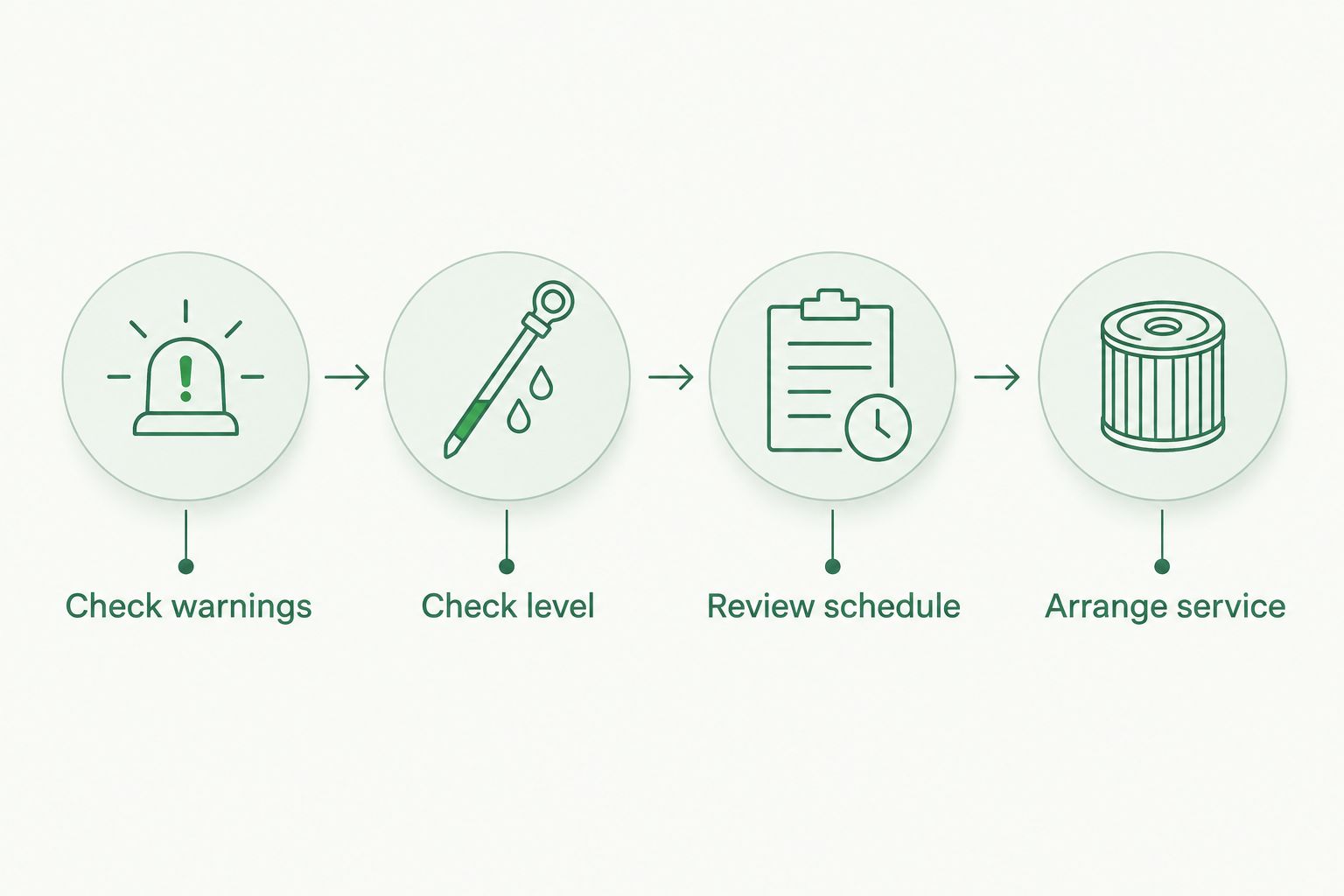
What to do when overdue
Start with the vehicle’s condition, not with the nearest open service bay. The goal is to decide whether you need routine service or help with a possible fault.
Check warnings
Read the dashboard message carefully. A maintenance reminder and an oil-pressure warning are not interchangeable.
If an oil-pressure warning stays on while the engine is running, pull over safely and shut the engine off. Follow the emergency instructions in your owner’s manual. Do not drive to an oil-change shop simply because it is nearby; arrange roadside assistance when needed.
Check level
If there is no immediate warning requiring you to stop operation, check the oil according to the owner’s manual. Follow its instructions for parking position, engine temperature, and when to take the reading.
Some vehicles use a dipstick, while others use an electronic level display. Add only the specified oil as directed, and do not overfill. A correct level afterward does not prove the engine is undamaged or explain why oil was low.
Review schedule
Find the last service record and compare it with the current odometer and date. Review the manufacturer’s oil specification and service requirements rather than relying only on a windshield sticker.
If the vehicle has an oil-life monitor, check its instructions too. Do not reset the reminder merely to silence it before the service is completed.
Arrange service
When the vehicle has no warning signs requiring diagnosis, arrange the overdue oil and filter change promptly. Tell the service provider if the history is uncertain, the level was low, or you have noticed oil loss.
Bolton Oil is best for Lubbock drivers who need a drive-up oil change, not engine diagnosis or repair. You can stay in your vehicle during service, but a suspected engine fault belongs with a qualified repair provider.
Make time without assuming a deadline
If scheduling is why you have postponed service, separate planning the visit from deciding whether the vehicle is safe to drive. An oil-pressure warning is not a scheduling problem. It requires stopping safely, even when an oil-change business is close by.
For a vehicle that needs routine service without emergency symptoms, understanding how long an oil change takes helps you plan the visit. Actual time includes the work and any queue when you arrive, so leave room in your day rather than treating an estimate as a promised completion time.
Bolton Oil has three Lubbock locations and accepts drive-up visits during business hours without appointments. That convenience removes the booking step; it does not mean a guaranteed wait or completion time.
What an oil change cannot fix
Fresh oil and a replacement filter restore an essential maintenance item. They do not rebuild worn bearings, repair an oil leak, or establish why an oil-pressure warning appeared.
Tell the service provider about symptoms before work begins. Mention noises, warning messages, oil you have added, or spots beneath the vehicle rather than assuming those details are unrelated.
If a repair provider diagnoses a mechanical problem, follow that repair guidance. Choosing a different viscosity, adding a treatment, or repeatedly resetting a reminder is not a substitute for correcting a fault.
After routine service, keep the record and continue checking the oil as your owner’s manual directs. An oil change gives you a documented service point, not permission to ignore changes between visits.
FAQ
Does dark engine oil mean I waited too long?
Dark oil alone does not establish that you waited too long. Oil can darken during normal use, so use the manufacturer’s schedule, service history, and applicable monitoring instructions rather than color alone.
Can I just add oil instead of changing it?
Adding oil does not replace an oil and filter change. It addresses a low level but leaves used oil and accumulated contaminants in the engine; recurring oil loss also needs evaluation.
Should I follow the windshield sticker or my owner’s manual?
Your vehicle manufacturer’s maintenance requirements are the reference for deciding when service is due. Ask the service provider to explain any difference between those requirements and the reminder on the sticker.
Can I reset the oil reminder before getting service?
Do not reset the oil reminder as a substitute for completing the required service. Resetting it changes the reminder, not the oil’s condition, and makes the maintenance history harder to follow.
Will one missed oil change automatically void my warranty?
A missed oil change does not automatically settle whether a repair is covered. Coverage depends on the warranty terms and the circumstances of the failure; keep maintenance records and consult the manufacturer’s warranty documentation.
What should I keep after an oil change?
Keep a service record showing the date, mileage, oil specification, and work performed. That record helps you plan the next service and document maintenance if questions arise later.
Give the next visit a baseline
The useful next step is not simply clearing the dashboard reminder. It is leaving with a known service date, recorded mileage, and the correct maintenance reference for your vehicle.
If your vehicle is overdue without warning signs requiring repair, stop by a Bolton Oil location during business hours. If it has an oil-pressure warning or abnormal engine noise, address that problem before driving in.
Related guides
- What is included in a basic oil change service?
- Full synthetic versus conventional oil
- Can you get an oil change without an appointment?