

Best for vehicles that require synthetic oil: full synthetic. Best for vehicles whose manufacturer permits conventional oil: conventional remains a valid choice. The full synthetic vs conventional oil change decision starts with your engine’s requirements—not the weather alone, your vehicle’s age, or a blanket recommendation to upgrade.
- Full synthetic vs conventional oil change: follow the vehicle’s required oil specification before choosing either option.
- Full synthetic generally offers better resistance to oxidation and better low-temperature performance than conventional oil.
- Conventional oil remains suitable when it meets every requirement in your owner’s manual.
- Bolton Oil Change offers conventional and synthetic oil options appropriate for your vehicle, without an appointment.
Why the choice matters
Two containers can show the same viscosity grade without meeting the same engine requirements. That makes the large lettering on the front—“full synthetic” or “conventional”—only part of the answer.
At Bolton Oil Change, we offer conventional and synthetic oil options appropriate for the vehicle. Bolton Oil Change is a good fit for drivers who want a drive-up oil change with help choosing oil that meets their vehicle’s requirements. We specialize in oil changes and closely related maintenance, not engine diagnosis or repair.
This 2026 guide compares oil types rather than ranking oil brands. The useful question is which option belongs in your engine and how to maintain it afterward.
What makes the right oil
Use these criteria before comparing the two choices:
- Vehicle requirement: Check whether your manufacturer requires full synthetic, recommends it, or permits conventional oil.
- Oil specification: Match the required performance standard and any manufacturer-specific approval, not just the viscosity.
- Viscosity grade: Use the grade specified for your engine and operating conditions. Don’t substitute a thicker oil simply because summer has arrived.
- Driving conditions: Check the maintenance schedule for conditions such as repeated short trips, towing, or dusty-road use when they apply to your vehicle.
- Service schedule: Follow the manufacturer’s mileage, time, or oil-life-monitor instructions. Synthetic oil does not create a universal extended interval.
The American Petroleum Institute’s Motor Oil Guide explains viscosity grades and API oil service markings. Your vehicle’s owner’s manual supplies the engine-specific requirements; neither a general comparison nor an oil container’s marketing description replaces those instructions.
Oil choices at a glance
| Oil type | Best for | Main advantage | Key limitation |
|---|---|---|---|
| Full synthetic | Vehicles requiring synthetic oil, or approved applications where its performance benefits matter | Generally better oxidation resistance and low-temperature performance | The synthetic label alone does not establish manufacturer approval or a longer service interval |
| Conventional | Vehicles whose manufacturer permits conventional oil meeting all required specifications | Meets the needs of eligible engines without requiring a switch to synthetic | Not a substitute where synthetic oil or an unmet manufacturer specification is required |
Neither option wins by name alone. A correctly specified conventional oil belongs ahead of an incorrectly specified synthetic oil in a vehicle that permits conventional oil.
1. Full synthetic: best for required applications
Full synthetic engine oil uses synthetic base stocks with an additive package designed to meet particular performance standards. Compared with conventional formulations, synthetic oils generally offer better resistance to oxidation and better performance at low temperatures. The exact capabilities still depend on the finished oil’s formulation and approvals.
If your owner’s manual requires full synthetic, this is not an optional upgrade. Choose full synthetic in the specified viscosity and with the required performance qualifications.
Full synthetic pros
- Generally resists oxidation better than conventional oil, helping the oil withstand demanding operating conditions.
- Generally provides better low-temperature flow, which matters during cold starts.
- Serves applications whose manufacturers require synthetic oil, provided the specific product meets the other requirements.
Full synthetic cons
- “Full synthetic” does not confirm that an oil carries your engine’s required manufacturer approval.
- Switching does not automatically authorize a longer oil-change interval.
- Synthetic oil does not repair oil leaks, mechanical wear, or an existing engine problem.
Best for: Vehicles requiring synthetic oil and eligible vehicles whose owners choose its performance characteristics.
For West Texas use, separate the oil’s capabilities from the maintenance schedule. Heat, towing, and dusty operation are reasons to check the manufacturer’s instructions—not permission to select a different viscosity or invent a longer interval.
Verdict: Buy full synthetic when required; otherwise, choose it only in a formulation approved for your engine.
2. Conventional: best for permitted applications
Conventional engine oil uses refined petroleum base stocks and an additive package. It remains an appropriate choice where the vehicle manufacturer permits it and the finished oil meets the required viscosity and performance specifications.
That qualification matters more than vehicle age. An older vehicle does not automatically need conventional oil, and a vehicle’s familiar maintenance routine is not proof that a particular oil meets its requirements.
Conventional oil pros
- Provides suitable lubrication in applications that permit conventional oil meeting the required standards.
- Lets you continue an approved maintenance choice without switching solely because synthetic is widely advertised.
- Can meet a vehicle’s requirements without making synthetic oil a necessity, where the manufacturer allows it.
Conventional oil cons
- Generally has less resistance to oxidation and less favorable low-temperature performance than synthetic formulations.
- Is not appropriate where full synthetic is required.
- Still requires careful checking of performance specifications; the correct viscosity alone is not enough.
Best for: Vehicles whose manuals permit conventional oil and whose required specifications are met by the selected product.
Don’t treat conventional oil as the default for a high-mileage engine. Mileage alone does not tell you which base-oil type, viscosity, or approval the engine needs. Service history, current requirements, and any symptoms deserve separate attention.
Verdict: Buy conventional only when your manufacturer permits it and the selected oil meets every required specification.
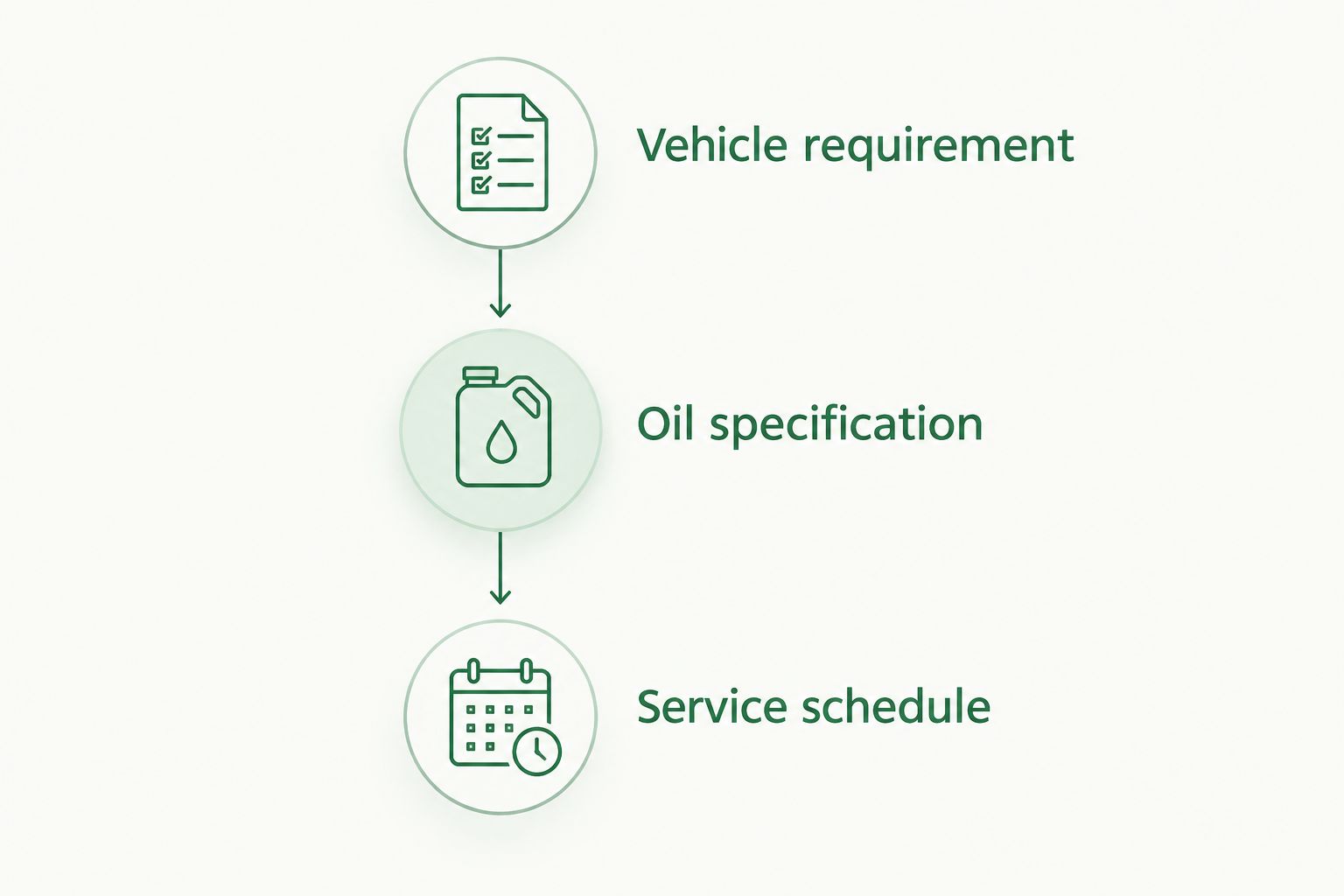
Check three things before service
You don’t need to become an oil specialist to make a sound choice. Bring the vehicle’s requirements into the conversation, then confirm the oil and schedule against them.
Vehicle requirement
Find the engine-oil section of the owner’s manual. Identify the correct engine if the manual covers several versions, and check whether synthetic oil is required or recommended.
Those words mean different things. A requirement sets a condition you must meet; a recommendation needs to be read alongside the manual’s permitted alternatives.
Oil specification
Match the viscosity grade and performance requirements together. Grades such as SAE 0W-20 and SAE 5W-30 describe viscosity classifications under SAE International’s engine-oil grading system; they do not identify whether the oil is synthetic or confirm every approval an engine needs.
Don’t read the numbers as simple outdoor-temperature limits. Follow the manufacturer’s listed grade and any permitted alternatives rather than choosing a different grade by season on your own.
Service schedule
Find the maintenance instructions that apply to your actual driving. Check both mileage and elapsed time, along with any instructions for the oil-life monitor and special operating conditions.
Changing oil types does not erase those instructions. Our guide to oil-change intervals by West Texas driving conditions addresses the scheduling side of the decision.
What West Texas changes
Dusty roads make the maintenance schedule and engine air filter worth checking. Engine oil and the air filter have different jobs: choosing synthetic oil does not replace a restricted filter or remove the need to inspect it according to the vehicle’s instructions.
Repeated short trips also deserve attention if your manual identifies them as a special operating condition. A trip across town is not automatically severe service; use the manufacturer’s definition instead of guessing from distance alone.
Summer heat does not create a universal requirement for thicker oil. Likewise, towing does not give every vehicle the same oil-change schedule. Follow the instructions for your engine, load, and use rather than borrowing advice from a different truck or car.
At Bolton Oil Change, engine air filter checks and replacement are part of our approved service offerings. They are separate from the question of whether conventional or synthetic oil belongs in your engine.
How the choices are ranked
Full synthetic appears first because it is necessary in vehicles that require it and generally offers stronger oxidation resistance and low-temperature performance. Conventional remains a valid choice for vehicles that permit it.
This is a requirements-based comparison, not a product test or a claim that every synthetic formulation outperforms every conventional formulation on every measure. The ranking puts manufacturer requirements first, then oil performance, driving conditions, and maintenance instructions.
Which oil should you choose?
Choose the oil that meets every requirement in your owner’s manual. If full synthetic is required, use it. If conventional is permitted and meets all the listed standards, it remains a sound choice; synthetic is an option, not an automatic obligation.
For your next visit, have the vehicle’s year, make, model, and engine information ready. If you have the manual’s oil specification available, bring that too. You’ll have a more useful discussion than simply asking for whichever oil is described as “best.”
Bolton Oil Change offers drive-up oil changes without appointments at three Lubbock locations during business hours. We can help you select an appropriate oil option without turning routine maintenance into a repair appointment.
FAQ
Can I switch back to conventional oil after using full synthetic?
Using synthetic oil does not permanently commit an engine to synthetic. Switching back is appropriate only if the vehicle manufacturer permits conventional oil and the replacement meets every required viscosity and performance specification.
Will synthetic oil fix an engine that burns oil?
Synthetic oil is not a repair for an engine that consumes oil. Follow the owner’s manual for checking the oil level, and have unexplained consumption assessed by a qualified repair provider rather than relying on an oil-type change.
Is high-mileage oil the same thing as full synthetic?
No. High-mileage describes a formulation intended for higher-mileage applications, while full synthetic describes the base-oil type. A high-mileage label does not replace checking the viscosity and manufacturer requirements.
Can my diesel truck use the same synthetic oil as a gasoline car?
Only if the specific oil meets the diesel engine’s required specifications and viscosity. Full synthetic is not a universal compatibility label, and gasoline-engine oil requirements must not be assumed to cover a diesel engine.
Should I reset the oil-life monitor when I add oil?
Adding oil is not an oil change and is not a reason to reset the oil-life monitor. Follow the vehicle manufacturer’s reset instructions after the required service has been completed.
Can I drive to an oil change if the oil-pressure warning stays on?
Do not treat an oil-pressure warning as a routine oil-change reminder. Stop safely, shut off the engine, and follow the owner’s manual’s warning instructions; arrange qualified assistance rather than assuming fresh oil will solve the problem.
One last thing
Before you leave your next oil change, confirm the viscosity and specification used—not just whether the oil was synthetic. Keeping that information with your service record makes the next visit easier and helps prevent an incorrect choice from becoming a repeated habit.
When you’re ready, stop by Bolton Oil Change during business hours. Bring your questions along with your vehicle.
Related guides
- Synthetic oil choices for West Texas summer heat
- Engine air filter replacement for West Texas driving
- Oil-change options for high-mileage vehicles